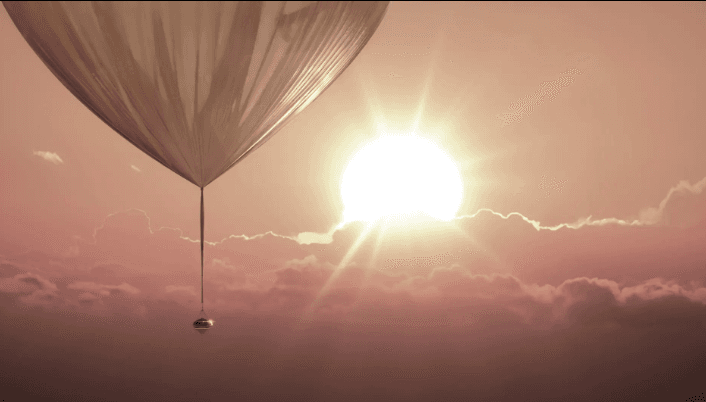
In the vast expanse of space, exploration has always been a driving force for human innovation. While traditional spacecraft have long been the primary means of venturing beyond our atmosphere, a new player has emerged in the realm of space exploration: space balloons.
These enormous, inflatable structures offer a novel approach to reaching the stars, providing unique opportunities for scientific research and exploration. Below, we explore the world of space balloons, examining what they are, how they work, the companies pioneering development, past missions, and the exciting future that lies ahead.
What Are Space Balloons?
Space balloons, also known as high-altitude balloons or stratospheric balloons, are large, inflatable structures designed to carry payloads into the upper atmosphere and even beyond. Unlike traditional spacecraft, which rely on rockets for propulsion, space balloons harness the natural buoyancy of gas to ascend to high altitudes. These balloons are typically made of lightweight, high-strength materials such as polyethylene, Mylar, orlatex, allowing them to withstand the harsh conditions of the stratosphere while carrying payloads ranging from scientific instruments to communication devices.
The space balloons that are used by NASA typically have a volume of40 million cubic feet. This is equivalent to over 195 Goodyear blimps, and when fully inflated, an entire football stadium could fit inside the balloon. These balloons are a cost-efficient option for carrying payloads up to 8,000 pounds into the atmosphere.
How Space Balloons Work
The principle behind space balloons is relatively simple yet elegant. Filled with a lighter-than-air gas such as helium or hydrogen, the balloon ascends through the atmosphere, gradually expanding as the air pressure decreases.
Once in the stratosphere, the balloon reaches a stable altitude determined by the balance between the gas’s buoyant force and the payload’s weight. Unlike rockets, which require immense amounts of fuel and propulsion systems, space balloons offer a cost-effective and environmentally friendly means of reaching high altitudes for scientific research and exploration.
Companies Leading the Charge in Space Balloon Production
Several companies have emerged as leaders in the field of space balloons, pushing the boundaries of what is possible in stratospheric exploration.
One such company isZephaltobased in France. They plan to offer six passengers a flight to a height of 15.5 miles at $132,000 per person, including fine dining and luxurious wine selections.
Another company in the space balloon race is U.S.-basedSpace Perspective. The company will offer eight passengers a flight up to 20 miles above the earth for $125,000 per person. Their vessel, the MS Voyager, is designed for water landings making it possible to scale operations globally.
Another leading company isWorld View, based in Tucson, Arizona. Their flight package includes the chance to speak with a psychologist before and after the 5-day trip, which will take them to an altitude of 20 miles. They are the lowest-cost option of the three, with an estimated cost of $50,000 per person.
Space Balloons in Action: Past and Present
Over the years, space balloons have been used for a wide range of scientific experiments and missions. NASA has been using space balloons for over 30 years to conduct research and have reached heights of 160,000 feet.
Space balloons have proven to be versatile platforms for scientific research, from studying cosmic rays and atmospheric phenomena to testing new technologies and conducting telecommunications experiments. In recent years, there have even been manned flights aboard space balloons, with brave explorers venturing to the edge of space to experience weightlessness and breathtaking views of the Earth below.
One of the most watched space balloon missions was in 2012, when Felix Baumgartner jumped out of a capsule carried to a height of127,852 feetby a space balloon. This “space” jump has been viewed over one billion times on YouTube.
The Future of Space Balloons
Soon, advancements in materials science and engineering will propel space balloon technology to new heights. Lightweight yet durable materials such as graphene and advanced polymers will enable space balloons to ascend to unprecedented altitudes, pushing the boundaries of stratospheric exploration. For example, companies like Space Perspective are already developing advanced materials and construction techniques to build larger, more robust balloons capable of carrying passengers on luxurious journeys to the edge of space.
The increasing capacity of space balloons to carry larger payloads will also revolutionize various industries. In telecommunications, for instance, companies likeLoon, a subsidiary of Alphabet Inc., are leveraging space balloons to provide internet connectivity to remote and underserved regions of the world. By deploying networks of high-altitude balloons equipped with communication equipment, these companies are bridging the digital divide and bringing connectivity to millions of people around the globe.
In the realm of climate research, space balloons offer a unique vantage point for studying atmospheric phenomena and monitoring environmental changes. NASA’s Super Pressure Balloon, for example, is designed to carry scientific payloads to the edge of space for long-duration missions,up to 100 days, allowing researchers to gather data on atmospheric composition, temperature variations, and other critical factors influencing climate dynamics. Such initiatives hold the potential to deepen our understanding of Earth’s climate system and inform strategies for mitigating the effects of climate change.
Furthermore, space balloons are poised to revolutionize the emerging industry of space tourism. Companies like World View Enterprises are developing luxury space balloon experiences, offering passengers the opportunity to soar to the edge of space in comfort and style. With panoramic views of the Earth below and the vast expanse of space above, these excursions promise to provide a truly unforgettable experience for adventurous travelers seeking to explore the final frontier.
A New Age of Space Exploration
Space balloons represent a new frontier in space exploration, offering a unique and cost-effective means of reaching the upper atmosphere and beyond. With their simple yet effective design, these inflatable structures have already proven their worth in scientific research and exploration.
As companies continue to push the boundaries of what is possible, the future of space balloons looks brighter than ever, promising exciting opportunities for scientific discovery and exploration in the years to come.
Image Credit: Space Perspective