
The aerospace industry relies on plastics, and it’s no wonder. Aviation-worthy composites create stronger, lighter aircraft. They lower energy consumption, cut weight, reduce costs, increase production rates, streamline manufacturing, and soften the environmental impact by shrinking carbon footprints and slashing toxic emissions.
And, of course, light-yet-robust materials like high-performance plastics are a necessity when protecting passengers during a commercial flight or sending spacecraft on missions.
Types of Aerospace Plastics
Aerospace sector applications abound. Thermosetting plastics are made of polymers, connected series or chains of similar or identical building blocks. Also called thermosets, thesethermosetting plasticsare soft solids or fluids that become irreversibly hardened (set) after heat treatment and the resultant formation of molecular cross-links.
Heat may be applied externally or result from a mixture of chemical ingredients. Once thermosets are formed into their final shape, they cannot be remelted. Examples include silicone resins, epoxy resins, fiberglass, and vulcanized rubber.
Thermoplastics, conversely, are polymers that can repeatedly become plastic (malleable) when heated and then toughen upon cooling. The heating-and-cooling process is reversible, unlike with thermosets, asthermoplasticsdo not form the proliferative microscopic cross-linkages that give thermosets their superior structural properties.
Composite plastic materials are high-performance plastics, reinforced with fillers, fibers, powders, particulates, and other matrix reinforcements to improve rigidity and strength. These additives include fabric, fiberglass, glass, or metal, yielding well-known and invaluable entities like epoxy resins, PEEK (polyetheretherketone), and carbon fiber-reinforced plastic.
Let’s examine some of the most common aerospace plastics.
Polytetrafluoroethylene (PTFE) is popularly known as Teflon™. It can provide durability and conductivity to spacecraft as well as satellites, protecting vital space investments from extreme temperatures and radiation. NASA used this material to protect the Mars Exploration Rovers project, valued at a not-so-trifling $1 billion.
To withstand truly otherworldly environs, the Spirit and Opportunity rovers’ critical components werefortified with Teflon resins. As a result, both rovers vastly outperformed their expected lifespans of 90 sols, or Mars days. Instead of the expected three months, the Opportunity rover continued rolling for nearly 15 years and covered a literal Martian marathon by traveling over 26 red, dusty miles.
Teflon also fortifies orbiting satellites and numerous aircraft components — including doors, cables, fuel hoses, and wings — thanks to its flexibility, superior dielectric properties, and thermal control up to 572 °F.
Aerospaceacrylicsprovide impact and craze (cracking) resistance. Some are thermally annealed, or heat-treated, to improve their ductility, making them easier to work with.
The superior optical grade of some acrylic aerospace materials gives great visibility as well as UV and solar heat control. As such, they’re used for canopies, windows, instrumentation, wingtip lenses, and outer laminates for military and non-military aircraft.
Polyetheretherketone, more simply PEEK™, stars in heavy-duty applications because it’s chemically unreactive, durable, and resists high-pressure water and steam when used in valves or seals. It functions well across a wide temperature range, with a continuous use temperature that is 500 °F.
PEEK is mechanically strong, resisting deformation (creep) and brittleness (fatigue) when formed into gears or other elements that face repeated wear. Due to its semi-crystalline structure, it’sstronger than many polymers and some metals.
ULTEM™ (polyetherimide or PEI) is from thesame family as PEEKbut is cheaper. It often replaces metal parts to reduce weight without sacrificing durability. With a high thermal resistance rating, these polymer components helpmilitary aircraftevade radar detection.
ULTEM is easily processed yet boasts fantastic durability to resist constant mechanical stress. Its advantageous thermal, electrical, and chemical properties make it shrug off the many assaults ofaerospace industry utilization, including contact with aircraft fluids. ULTEM is also used in oxygen panels, ventilation systems, and galley equipment, such as ovens, since it is food-contact safe.
Torlon® polyamide-imide is incredibly tough, providing strength, stiffness, and extraordinary temperature resistance of about 500 °F. It is resistant to chemicals and radiation. It is also flame retardant anddoesn’t emit smokeif caught in a conflagration.
Owing to its passenger safety potential, this material often replaces metal in aircraft. Torlon is also used for making bearings because it stands up to mechanical pressure and features self-lubricating properties.
Thermosetting polyimide, orMeldin® 7001, is flexible, light, and chemical resistant. It helps keep high-pressure parts from deforming, with applications such as threading nuts and the spacers that keep wheels in proper alignment.
Another tongue-twisting name,polychlorotrifluoroethylene, thankfully also goes by Kel-F® or PCTFE. It’s a fluorocarbon that resists fire and chemicals. It’s almost impermeable to gas. It has great electrical properties and absorbs almost no moisture. PCTFE is a common structural material because it’s strong and stable. It can resist prolonged physical stress and a
temperature range of-400 °F to 380 °F.
Polyoxymethylene,POM, features low friction, high stiffness, and enviable dimensional stability that helps it hold its shape. This rigid plastic is also unaffected by moisture, chemicals, and temperature. These properties produce versatility, as POM is used in fuel system components, door handles, and gears.
Ultra-high-molecular-weight polyethylene, UHMW, offers formidable strength at a low cost. It’s easilymachinedand effectively withstands impacts, abrasion, and corrosion from solvents or
fuels. It also has a low coefficient of friction and favorable resistance to external environments, so it’s commonly used on aircraft wings and wingtips.
Applications of Aerospace Plastics
Plastics are aircraft manufacturers’ best friend, boasting many material and manufacturing advantages. Over the past 70 years, plastics have enshrined themselves as the best choice for myriad aerospace applications and are becoming more ubiquitous with each successive generation.
The plastics used in the aviation industry today offer durability, are lightweight, and have uncompromising support. They are well-suited for airframes and other structural components, both internal and external, to improve performance and efficiency.
Corrosion, temperature, electrical, and chemical resistance make plastics indispensable in engine parts, electrical systems, and fuel systems. Comfort and safety dictate the design of primarily plastic interiors.
Back-lit panels and LED lights are made from TUFFAK® polycarbonate. Whereas Vespel® materials, such as DuPont™Vespel®, may be favored for fasteners and splines because they’re less likely to damage connecting parts. These choices display great stability under a wide range of mechanical stress and the severe thermal flux of catapulting from cryogenic conditions to temperatures of “550 °F with excursions to 900 °F.”
Exquisite sealing ability also plays a key role in valves, as much of the aerospace industry relies on the constant, controlled exchange of numerous types of gases and liquids, including hydraulic fluids, coolants, lubricants, and cabin air. To ensure reliability, valve seats and seals are often made from plastics such as PEEK, PCTFE, and DuPont™ Vespel®.
The following are among the manycomponents comprised of plastics:
Plastics also safeguard the most irreplaceable component of all: humans. That’s why KYDEX® thermoplastics and Royalite® rigid ABS/PVC thermoplastic materials are used in aircraft interiors. They stubbornly resist fires, impacts, and cleaning chemicals to yield durable, safe interior items such as tray tables and seats.
Advantages of Aerospace Plastics
It’s an understatement to say that plastics provide manybenefitsin aerospace. Thanks to favorable costs, versatility, and mechanical properties, metal hegemony is becoming a thing of the past.
Plastics’ protective properties are essential for nacelle systems, which surround and safeguard engines, gas tanks, delicate electronics, and other equipment. Plastic-based fan cowls, thrust reversers, and other highly engineered, complex parts also receive numerous advantages, including weight reduction, cost-effectiveness, improved efficiency, and design flexibility.
Plastic partsmay cut manufacturing time by 80%— from hours to minutes — and slash the weight of parts by 50% compared to their heavier, metal-bound predecessors. Significantly, engineering-grade plastics are only half as dense as aluminum or glass andone-sixth as dense as steel.
Additionally, plastics form tight seals, offer electrical insulation, and boast excellent temperature, humidity, and corrosion resistance. Plastics bear loads and shrug off constant wear, withstanding the rigors of impacts, vibrations, abrasions, fire, smoke, and repeated use cycles. Outstanding chemical resistance keeps intricate, frangible parts from degrading, negating repair costs and boosting component lifespans.
Aerospace plastics impart advantageous aerodynamics, enhancing fuel efficiency while potentially skipping supply chain issues (i.e., metals procurement). Such light pliability also provides plasticity, facilitating simpler repairs to further save time, cost, and labor.
Fortunately, lighter-weight alternatives do not sacrifice strength for weight, since plastics can be just as robust as their metallic counterparts. So it’s no surprise thatBoeing’s 787 Dreamlineris known as “the plastic airplane.”
Plus, easy moldability (and perhaps re-moldability) furnishes aerospace engineers and designers a glut of choices for texture and color, including transparency for windows and canopies.
Increasing efficiency and bolstering environmental sustainability bodes well in all realms. Decreased gas use leads to lower prices and reduced environmental impact, helping to cut greenhouse gas (GHG) emissions.
Lifecycle emissions may also shrink, as plastic production does not require the energy-intensive autoclaves used to fashion metal parts. Some plastics may be recyclable, but it depends on their use, condition, and composition.
Challenges and Future Trends in Aerospace Plastics
There will be more and better plastics in the future of aerospace. Since World War II, advanced polymer composites have supplanted much of the metal that was used, a trend that will keep soaring as material science continually improves. Therefore, the primary challenges are to ensure that these plastics meet the many stringent requirements of aerospace use, including resistance to fire and an ability to be easily cleaned.
Another weighty concern isrecyclability, as composites face uncertain reusability potential. Additionally, processes to reclaim composites can release toxic volatile gases, and landfilling parts or sending derelict craft to graveyards can lead to, among other concerns, fragmentation of materials and the spreading of microplastic pollution.
Taxes and incentives could spur the aero-plastics industry to innovate more comprehensive recycling methods, choose plastics with optimal end-of-life disposal options, or alter their composition to create more sustainable composites.
Novel chemistries, like those in the works at the University of Colorado Boulder, could split plastics into their “most basic building blocks” to give them a second, hundredth, or thousandth life.
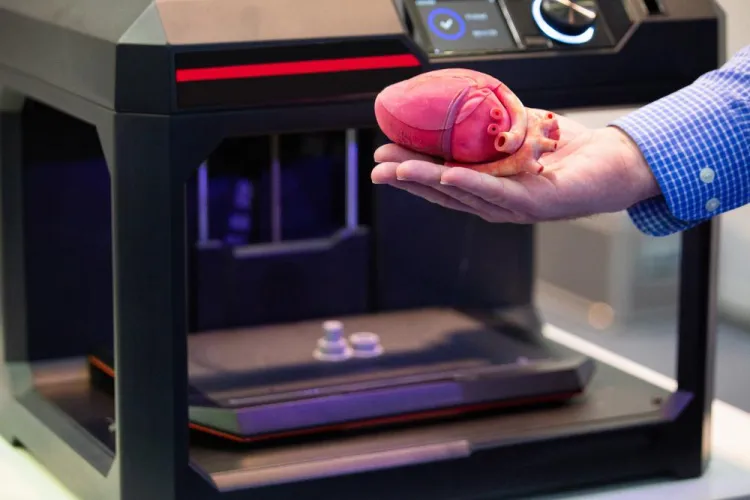
Additive manufacturing (AM), also known as3D printing, is expanding the aerospace and aviation airscape by allowing easy creation of fluid designs that can be tweaked, tested, and computer-supplemented at unprecedented rates. The most complex, convoluted geometries are now a breeze, often producing better components with fewer parts.
Computer-aided design (CAD) has enhanced numerous craft components while printing technologies decrease material use, avoid waste, and lower weight. Equally integral, AM can be as readily achieved in a factory as in situ —well above Earth’s surface— or anywhere else that on-demand, supply-chain-independent production is desired.
According to Grand View Research, theglobal aerospace plastics market sizewas
$7.61 billion in 2023 and is forecast to reach $13.89 billion in 2030, growing at a CAGR of 9.0% during the forecast period of 2023-2030.
The leading application segment? Cabin interiors: seats, galleys, overhead storage compartments, dividers, brackets, and other cabin elements. Previously, these items were made primarily from metals, but modern plastics offer the same FAA flammability regulations while dropping pounds and increasing comfort.
Structural components are the next-leading segment, with composites lowering weight by 20% and reducing maintenance needs. The switch to plastic is set to cement PEEK and POM as two sought-after materials thanks to their durability, corrosion resistance, and thermal profile.
Upcoming advances also promise toimprove existing plasticsby boosting strength and temperature resistance through composite reformulations bolstered by glass or carbon fibers. The required parts could be quickly, easily, and cheaply heat-shaped from sheet stock by leading aerospace companies.
The future is plastic. Aviation and aerospace are integral to the modern world, and plastic offers the agility needed to continue innovating.
Learn more about how you can give your aerospace supply chain a boost withmanufacturing on demand.