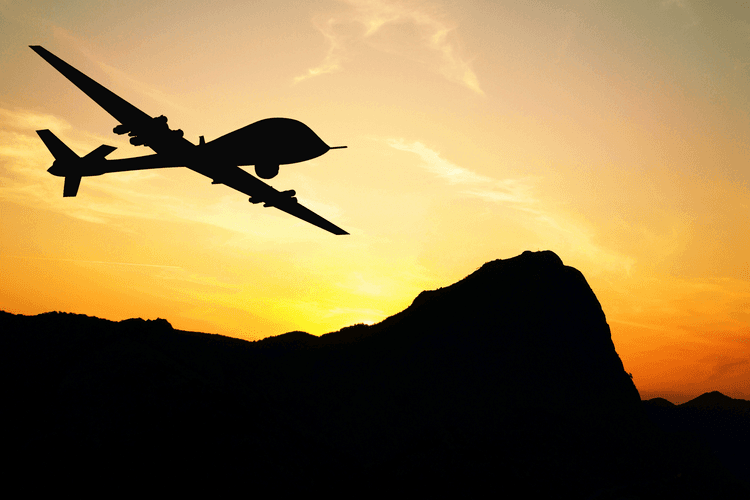
On Tuesday, March 14, a Russian warplane struck the propeller of an American surveillance drone. The MQ-9 Reaper drone, manufactured by California company General Atomics Aeronautical Systems, Inc., had been on a reconnaissance mission when it was downed into the international waters of the Black Sea.
From military uses to autonomous deliveries and aerial LiDAR, how is drone technology evolving in 2023?
What Is a Drone?
The Federal Aviation Administration (FAA) defines an unmanned aerial vehicle (UAV) — or drone — as any powered aircraft that does not carry human pilots, crew members, or passengers. To stay in flight, the majority of drones are powered by lithium-polymer batteries and are either fixed-wing or rotary. One of the most popular types of drones is the quadcopter, which boasts four motors.
Non-autonomous drones are fitted with a computer system or remote control that must be operated by a ground-based pilot.
Autonomous drones have computer vision and image processing functionalities, which leverage cameras and sensors to map a device’s surrounding environment and detect obstacles. These technologies can also identify landmarks and objects, enabling autonomous drones to pinpoint their precise position.
Drones range from insect-size, like the 6×1 inch Black Hornet, to the size of a passenger jet, like the RQ-4 Global Hawk. A modest, personal drone can be purchased for as little as $30, while a device like the RQ-4 Global Hawk is priced at around $130 million.
Not only do drone designs vary enormously, but their applications are increasingly wide-reaching.
A lot of people use drones recreationally; to play with in their gardens or for amateur photography projects. Indeed, the global consumer drone market is expected to reach $11.5 billion by the end of the decade.
But these devices are also used for military purposes — such as search and rescue missions and transporting nuclear weapons — monitoring climate change, security and surveillance operations, and package delivery.
Let’s explore drone usage in 2023.
How Drones Are Being Used Today
1. Global Military Drone Use
Due to the rise of lower-budget military devices, many nations are investing in drone technologies for military use.
Between August and November of 2022, for example, Russia sent more than 400 Iranian-made attack drones to Ukraine, including the Mohajer-6, Shahed-136, and Shahed-131. Devices like this are cheaper to manufacture, difficult to intercept, and can be deployed in large numbers. In November, it was reported that Ukraine was running out of air-defense weapons to combat drone strikes of this kind.
One of the most notable aerial combat vehicles is the Bayraktar TB2, which was designed by Turkish company Baykar Technology for use by the Turkish Armed Forces. This drone costs $5 million, travels at 138 mph, has a communication range of 186 miles, and can stay in flight for more than 27 hours.
2. U.S. Military Drone Investment and Research & Development
By 2029, the U.S. military is expected to invest $2.7 billion in drone research and development and $3.3 billion in procurement. The total figures could be much higher, however, since additional budget will likely be assigned to classified projects.
These investments will support the development and acquisition of military drones used for intelligence gathering, reconnaissance, search-and-rescue missions, equipment and weapon delivery, and combat. They will provide the U.S. military with a tactical advantage and help limit soldier fatalities on the battlefield.
To date, the U.S. army has leveraged a variety of drones. Notably, this includes General Atomics’ MQ-20 Avenger (Predator C), a combat drone that operates at speeds of up to 400 KTAS, reaches an altitude of over 50,000 feet, and has 20+ hours of endurance.
The U.S. Department of Defense (DoD) currently operates more than 11,000 drones, including the RQ-4 Global Hawk, in support of domestic training events and overseas contingency missions.
Northrop Grumman created X-47B as part of the U.S. Navy’s Unmanned Combat Air System (UCAS) Carrier Demonstration program. This combat drone device was designed to help the Navy explore the future of unmanned carrier aviation.
3. Consumer Drone Delivery Services
The widespread adoption of autonomous delivery drones has been a long time coming. And yet, thanks to increasingly sophisticated drone technology and an influx of new FAA regulations, 2023 might be the year that these devices start fully delivering on efficiency, cost-effectiveness, and reliability.
For starters, five companies, including Amazon, Zipline, Wing Aviation, Causey Aviation, and UPS, have been awarded Part 135 Air Carrier Certification, which means they do not have preset limits on the available size or scope of their operations.
Amazon is testing its drone deliveries in California and Texas, Walmart’s drone delivery is available in select markets in Texas, Arizona, and Florida, and Flytrex received FAA approval to double its delivery radius to two nautical miles.
Some of the biggest hurdles delivery drone manufacturers face is developing devices that can withstand volatile weather conditions, heavy loads, and long-distance travel. Mitsubishi Electric has developed a drone-based logistics platform to bring shippers, drone manufacturers, drone operators, and other service providers under one roof.
The drone package delivery market is projected to grow from $228 million in 2022 to $5,556 million by 2030.
4. Aerial Light Detection and Ranging (LiDAR)
Aerial LiDAR (light detection and ranging) is an aerial mapping technology that sees a device send laser pulses to a surface and measure the time it takes for the laser to return to its sensors. This information is used to make high-resolution point clouds of terrain.
While this technology has long been used in manned aircraft to gather data sets related to terrain, power lines, construction projects, and stockpile measurements, it is proving particularly useful when integrated with drones, which are more affordable and capable of navigating more challenging environments.
LiDAR drones have applications in various industries, including construction, manufacturing, insurance, agriculture, and archeology. They can map small power-line corridors and road construction projects, where it may not be cost-effective to pay for a manned aircraft; produce a comprehensive 3D map of an accident before emergency response teams arrive; and support agriculture and conservation efforts by providing up-to-date information on crop production or natural resources.
Get More Drone Insights
- U.S. Air Force to Purchase 1,000 Wingman Drones
- NASA, Northrop Grumman Team Up to Build Cargo Drones for Aerospace
- Drone Sails into Category 4 Hurricane to Collect Data







![Where Does New York City Get Its Electricity? [A Byte Out of the Big Apple]](https://machinerys.net/upload/cache/202507/where-does-new-york-city-get-its-electricity-a-byte-out-of-the-big-apple.webp)