“Help me, Obi-Wan Kenobi. You’re my only hope.”
Ever since Star Wars: A New Hope premiered in 1977, the most famous (albeit fictional) example of a hologram has been Princess Leia’s shimmering plea for help. Over 40 years later, holographic technology is a growing trend with uses including anti-forgery safeguards on banknotes and credit cards, heads-up displays in aircraft and automobiles, and several pragmatic functions in industrial companies including product testing and scanning.
What Are Holograms?
In simple terms, a hologram "is produced by measuring the reflection of coherent light on a surface, then comparing subsequent reflections after the surface is altered in some way.”
There are several different types of holography, but the technique most applicable to manufacturing is holographic interferometry. “As the holographic recording process is dependant on the interference pattern between optical-waves, the holographic image is the comparative shape between these waves,” Holocenter explains. "Holographic interferometry utilizes this property to detect small variations in form, with applications in industrial testing.”
The holographic global market will reach $19.1 billion by 2020, with the U.S. being the largest and fastest-growing regional market with an 8.5% CAGR according to a 2019 report from Global Industry Analysts. This growth is driven primarily by technology advancements, new applications, and its use in holographic non-destructive testing (HNDT).
How Are Holograms Used in Industry?
Holographic technology is used across a range of industrial applications:
- Quality Control: With fault tolerance in automobile and aircraft production steadily diminishing, digital holography has proven itself superior to visual inspections with its ability to achieve 100% detection of micro defectsduring production in a matter of seconds with micrometer accuracy. The technology-enabled Wener Giessler GmbH (a supplier to Bosch) increased production from 6.5 million to 10 million components per year without a single defective part due to 100% inspection through digital holography. Researchers had to find a way to negate the effect of vibrations before this technology could be successfully applied to production environments.
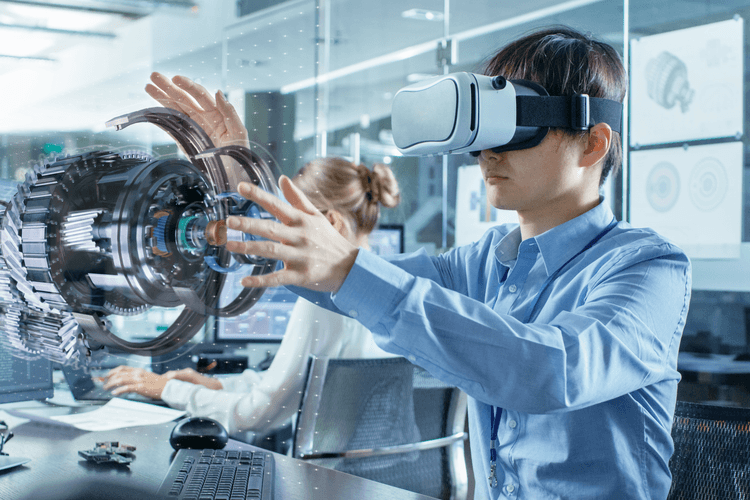
- Product Design: Product design, already revolutionized by CAD/CAM technology, is being further enhanced by the use of holography to create 3D models of designs, so engineers can more effectively visualize and manipulate designs as if they are physical objects.
- Test Sample Assessment: Holographic interferometry can locate and evaluate defects such as cracks, stresses, voids, and homogeneity inside test samples without damaging the samples. It is also used for measuring defects on the surface of test samples.
- Barcode Scanning: The difficulties involved in lining up a barcode with a laser scanner has been overcome with the development of holographic scanners. Capable of focusing at varying distances, these multidirectional scanners use multiple lenses that can read barcodes from any height or angle. Holographic scanners are used to greatly increase the speed of scanning in material handling, warehousing, and packaging.
- Smaller Machinery: SourceTech reports that the use of holographic elements in industrial machinery has resulted in the manufacture of smaller, less-expensive machinery.
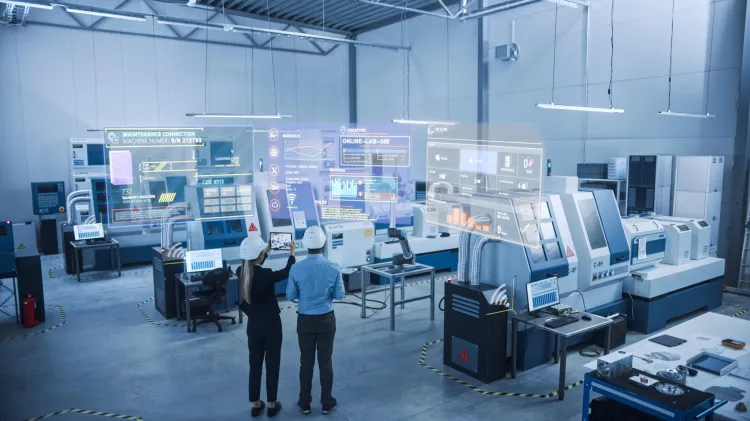
- Heads-up Displays: Holographic technology is used in heads-up displays (HUD) in aircraft and high-end automobiles to provide the operator with hazard and map-based information. In a manufacturing environment, a holographic HUD would be useful for providing diagnostic and repair instructions or status information to workers to enable them to work without looking down at a document or screen. Holographic HUD technology is also ideal for simulation training and may end up competing with virtual-reality headsets in this space.
- Packaging: From a marketing perspective, holographic technology can be used by manufacturers to create eye-catching packaging. Holographic patterns are difficult to counterfeit, making them a popular feature of all kinds of products from state IDs to premium cosmetics.