Thanks to rapid advancements in size, speed, affordability, functionality, and useability, the global industrial automation market is expected to hit $265 billion within three years.Automation promises lower operating costs, improved worker safety, a higher return on investment (ROI), better product quality, operational efficiencies, and competitive advantage.
Below are just a few of the top automation trends for industrial businesses in 2023.
1. A Rise in Sustainable Manufacturing
The U.S. Environmental Protection Agency (EPA) defines sustainable manufacturing, also known as green manufacturing or eco-friendly manufacturing, as “the creation of manufactured products through economically sound processes that minimize negative environmental impacts while conserving energy and natural resources.”
In pursuing sustainable manufacturing, industrial businesses can limit the harm inflicted on local environments, reduce their output of harmful emissions, cut their energy consumption and use of raw materials, and improve worker safety.Historically, there have been obstacles to adoption. As recently as November 2022, a Capgemini Research Institute report revealed that 53% of business leaders believe the costs associated with implementing sustainable business practices outweigh the benefits.
The rise of automation looks set to change this. Indeed, the same report found that 58% of organizations are already using artificial intelligence (AI) and automation to achieve their sustainability objectives. Additive manufacturing can significantly reduce materials waste, while automated data collection solutions are used to closely monitor how an organization is advancing towards its sustainability goals.
A reduction in energy consumption is a key measure of an organization’s sustainability efforts. While manufacturing giants may choose to invest in on-site renewable production, be it wind turbines or solar panels, smaller businesses can use other technologies to make incremental changes. Predictive maintenance tools, for example, can be applied to reduce energy loads and control material and water wastage while automating components of the production line serves to drive operational efficiencies.
2. Addressing Skills Shortages
Perhaps the most obvious benefit associated with the rise of automation is a reduced dependence on human resources. While there is an overall fear of robots taking jobs from humans, in reality,industrial businesses are turning to automation to overcome an ever-growing skills gap, which is expected to persist through 2023 and beyond.
To give just one example, the American Welding Society projects that the U.S. will face a shortage of 400,000 welders by 2024. Each year, demand for manufacturing workers is increasing, and it’s predicted that there will be two million manufacturing roles left vacant by 2030.
Automating the most repetitive elements of the manufacturing process can drive enormous efficiencies for industrial businesses. Not only can robot workers perform tasks quickly and consistently, but they can do so at every hour of every day.
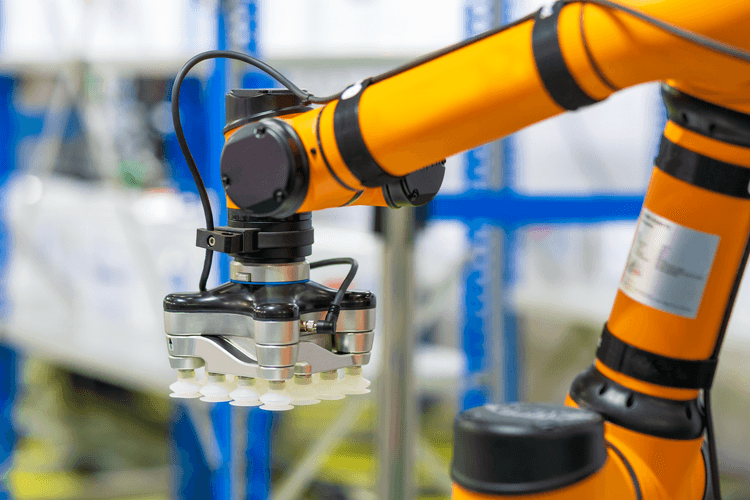
Recent developments in computer vision algorithms, technical vision devices, and overall computational power have given rise to fully autonomous collaborative robots (cobots) that can pack, weld, inspect, and assemble alongside their human counterparts. Indeed, the cobot industry is projected to grow to $2.2 billion by 2026. Cobot technology, like tele-manufacturing, is one process trying to close the skilled trades shortage.
As the year progresses, we can expect to see industrial robots assume increasingly complex tasks, alleviating the strains inflicted by an unwaveringly tight labor market.
3. A Rise in Modular Production
Modular production subdivides production linesinto smaller sections called modules.These modules exist as distinct cells rather than sequentially within a production line, which means they can be applied to different systems within an industrial business facility. A modular system drives the greatest efficiencies when robots and human employees can work side-by-side, something that cobots will facilitate more readily in 2023.
The advent of autonomous cobots is also supporting the rise of this manufacturing method since these machines are typically smaller, lighter, and easier to assemble and deploy than the giant industrial robots of yesteryear.
Because assembly time is minimized and the specific components within each module can be quickly switched in and out, modular production facilitates mass customization. This enables a customized product to be manufactured with the same ease, efficiency, and cost as a mass-produced one, resulting in higher quality products, better ROI, and more satisfied customers.
Another benefit of modular production is that it makes it more straightforward for industrial businesses to gather and analyze data from a specific module, which can inform production strategy and optimize assembly line monitoring and maintenance activities.
4. Turnkey Solutions Take Center Stage
Universal Robots (UR), a cobot pioneer, believes that this will be the year of turnkey solutions.In January, which UR has dubbed “National Cobot Awareness Month,” the company revealed its top automation predictions for 2023.
“We are going to continue seeing phenomenal growth within complete robotic systems for applications such as welding, palletizing, and machine tending, propelled by UR partners creating full solutions powered by our collaborative robot arms,” said Joe Campbell, senior manager of applications development and strategic marketing at UR.
As of January, the company has established partnerships with more than 80 original equipment manufacturers (OEMs) that are integrating UR cobots into turnkey systems.
This approach incentivizes industrial businesses to automate their processes since the burden of designing, manufacturing, installing, programming, and operating the solution is largely outsourced to an external contractor. This saves industrial businesses time, money, resources, and effort.
In addition, more no- and low-code automation solutions are expected to reach the industrial automation market. As with turnkey solutions, these applications are easier for industrial businesses to implement since no advanced programming skills are required.
5. A Decline in Warehouse Automation
Following the outbreak of COVID-19, e-commerce business boomed. According to the Census Bureau’s Annual Retail Trade Survey (ARTS), consumer sales via e-commerce increased by 43% in 2020, rising from $571.2 billion in 2019 to $815.4 billion the following year.
To accommodate this sudden shift in consumer behavior, many industrial businesses were quick to expand their distribution center (DC) networks, sparking record-breaking growth for warehouse automation solution providers. Indeed, in 2021, the market grew by a whopping 28%, with revenues reaching $36 billion.
But Amazon accounted for a pretty large slice of that pie — 35%, to be exact. As the pandemic-driven e-commerce spending frenzy subsided, the tech giant, and other major buyers of warehousing automation technologies, began scaling back their DC expansion plans.
This has triggered a temporary drop in the warehouse automation market, with Interact Analysis predicting just 2% growth for 2023. Fortunately for the industry, the dip won’t last for long. The market is expected to grow at a 19% compound annual growth rate (CAGR) between 2024 and 2027, in line with the continued steady growth of e-commerce.