When a barista at a coffee shop asks me to spell my name before scribbling it on a cup, I always fall back on one explanation for easy clarity: “It’s spelled like the Brooklyn Bridge.” Although I only recently visited Brooklyn, New York, for the first time, the U.S. monument is so famous that it never requires further explanation.
Monuments, which are statues, buildings, and structures erected to celebrate a notable person or event or that constitute historical interest, have served as examples of exceptional architecture for decades. They’re so recognizable that when they appear in popular culture — like Mount Rushmore in Mars Attacks! or the Statue of Liberty in Spider-Man: No Way Home — it’s no question where iconic film scenes are taking place.
Below, we explore the processes and materials behind some of the most famous U.S. monuments.
1. The Statue of Liberty
Standing over 305 feet, the Statue of Liberty is as tall as a 22-story building. The famous monument was built in 1886 and was the tallest manmade structure in New York at the time. Interestingly, the monument served as a lighthouse between 1886 and 1902, where its torch could be seen 24 miles away at sea.
When it comes to its construction, the Statue of Liberty has an iron frame covered by 2.4-millimeter-thick copper or the equivalent of two pennies stacked on top of each other. The benefits of copper are that it’s malleable and corrosion-resistant, making it easy to work with. The statue is now green as the copper has naturally oxidized over time. The torch flame is coated with gold leaf.
Under French activist Edouard de Laboulaye’s watch, artists and craftsmen constructed separate pieces of the statue over many years using various techniques. After the iron framework was built, the rest of the statue was assembled without scaffolding. Instead, construction materials were hoisted by steam-driven cranes. The statue’s “skin” used the repoussé technique, which required molding light-weight copper sheets and hammering them onto the hallowed framework.
2. The Brooklyn Bridge
When the Brooklyn Bridge was named a national monument by the U.S. Department of Interior’s National Park Service in 1964, it was said that the bridge “possesses exceptional value in commemorating and illustrating the history of the United States.”
Construction of the New York bridge began in 1869 and used a new design: woven wire cables. Spanning 6,016 feet, it was the longest suspension bridge in the world at the time of construction. The towers of the bridge are made of limestone, granite, and cement. While iron is the main building material, steel makes the bridge strong and durable.
Representing a brilliant feat of 19th-century engineering, the bridge was the first to use steel for cable wire. To get a solid foundation for the bridge, workers hollowed out the riverbed in giant wooden boxes attached to the river’s floor by enormous granite blocks. It took more than 600 men to build it over 14 years.
3. Mount Rushmore
Another monument that required the collaboration of hundreds of workers was Mount Rushmore in South Dakota. After 90% of the monument was carved using dynamite, workers were hoisted down the structure using thick steel cables to do the intricate carving of former U.S. presidents George Washington, Thomas Jefferson, Theodore Roosevelt, and Abraham Lincoln.
Mount Rushmore is primarily made of granite and much older metamorphic rocks. More than one and a half billion years ago, a mass of molten rock rose from the Earth’s crust. When the mass cooled, it formed the granite that makes up the Black Hills and the upper portion of Mount Rushmore.
4. The Washington Monument
In 1848, construction began on the Washington Monument, which is the shape of an Egyptian obelisk and evokes “the timelessness of ancient civilizations.” It was built in Washington, D.C., to embody the United States’ gratitude for its first president, George Washington.
Standing at around 555 feet tall, the monument is made of granite, marble, and bluestone gneiss and is the world’s tallest structure made of predominantly stone. The main body is made of granite from various quarries in New England and faced with marble from Maryland.
When construction was paused during the Civil War, and due to lack of funding, there was discussion about tearing it down and starting over. Instead, the upper two-thirds of the monument does not match the bottom, as the white marble came from different quarries in Maryland and was combined with granite from New England. Over time, environmental elements aged the two marble elements differently.
5. The Gateway Arch
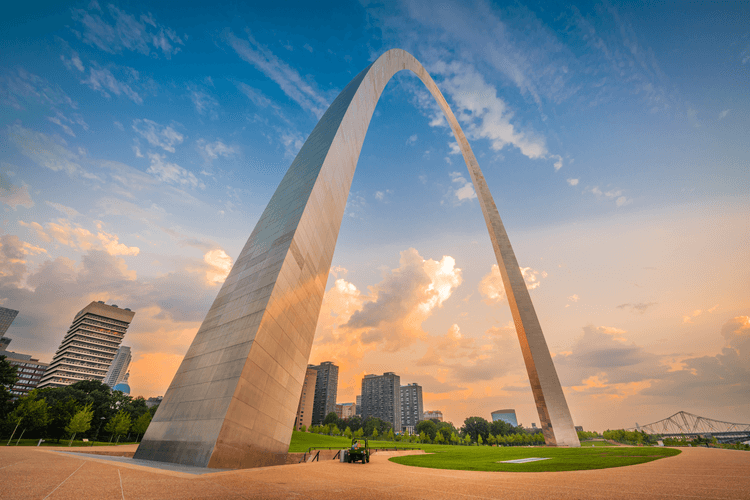
Rising 630 feet high, the Gateway Arch is the tallest manmade monument in the United States. Located in St. Louis, Missouri, to commemorate Western expansion, construction began in 1963 and was completed in 1965.
When looking at the arch, the stainless steel exterior shines. Inside, there are stairs and a tram that lead to the very top. Each year, around a million visitors take the 4-minute tram ride. The arch uses the orthotropic design, borrowing from the historic Eads Bridge over the Mississippi River.
The complex engineering of the arch is entirely hidden. Under the arch is carbon steel, which combines with the outer stainless steel to “carry the gravity and wind loads to the ground.” It’s built to withstand 150-mile-per-hour winds and sway as much as 18 inches. Interestingly, the arch doesn’t have a real structural skeleton. Instead, the inner and outer steel create a composite structure to keep it standing.
Related Insights:
- What Are California, Texas, and Other States Known for Manufacturing?
- From Michigan’s Racecars to New York’s Apple Trees: Iconic Products of 11 States
- How Was the Statue of Liberty Assembled? [A Byte Out of the Big Apple]