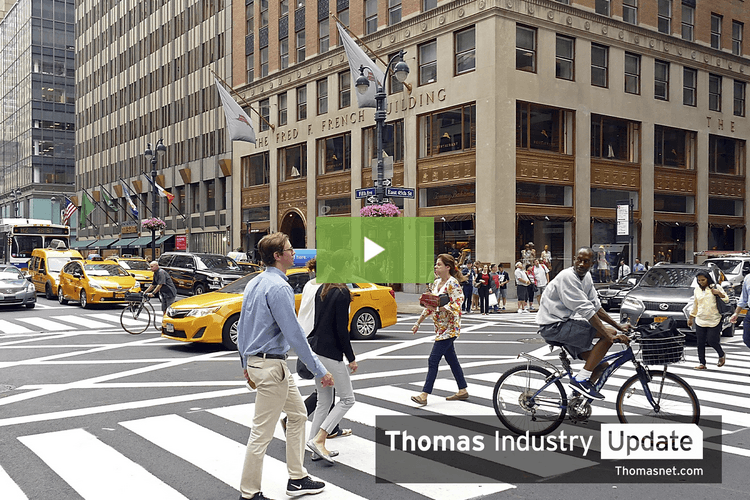
Bustling city settings where vehicles, public transportation, and pedestrians share space have always been ripe for accidents. In Japan, decades of work have gone into trying to reduce the number of annual pedestrian deaths due to traffic accidents. And while Japan’s fatality rate in these incidents hit a record low in 2020, automakers like Honda are also getting in the game in an attempt to drop the rates further still.
Through a partnership with tech investment firm SoftBank, Honda is testing a new alert system that puts the onus of safety on both vehicles and pedestrians.
Hokkaido, Japan, is serving as a test bed for the new tech, which assesses area roadways for poor visibility. When it identifies a pedestrian who could be blocked from view by a parked car or other roadway impediment, the system uses wireless technology to send an alert to drivers of nearby cars and the pedestrians. It also can jolt a pedestrian who might not see an oncoming vehicle coming with a signal sent directly from that car, whose on-board cameras recognize the potential risk.
Honda says the system uses 5G and cellular communication to support the alert system, some of which would even be vehicle to vehicle — in a case where a pedestrian hidden from view of one vehicle could be identified by another and a message shared between both. Honda says the goal of partnership is “to realize a cooperative society where pedestrians and drivers can enjoy mobility safely and with total peace of mind by utilizing network technology that will be created by connecting pedestrians and vehicles.”
Many observers on the internet had the exact same initial thought that I did, which is: why would you further distract a pedestrian who is in danger of being run down in a crosswalk by encouraging them to pause and look at their phone?
Well, the idea appears to be that users with the alert system enabled would receive an audible alarm or vibration that indicates there could be an oncoming vehicle, so, more like a nudge to look up, rather than to look down.







![Just Laser It Away: How Tattoo Removal Works [Thoughts After Dark]](https://machinerys.net/upload/cache/202507/just-laser-it-away-how-tattoo-removal-works-thoughts-after-dark.webp)