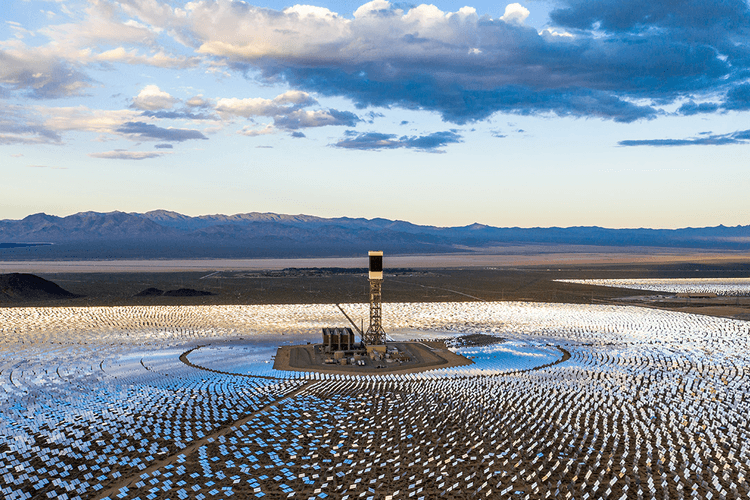
Shining bright in the dusty and dry Mojave Desert, just 43 miles southwest of Las Vegas, is the world’s largest concentrating solar power (CSP) plant: The Ivanpah Solar Energy Facility. Spanning 4000 acres of land, the plant generates enough energy to power 140,000 homes.
The sight of 300,000 mirrors surrounding three, 450-feet-high, glowing beacons is quite something to behold. So much so that The Fray, an American rock band, was inspired to shoot the video for their single Love Don’t Die from within the sea of Ivanpah’s mirrors, and titled their 2014 album, Helios, after the ancient Greek god of the sun. Of course, the facility serves a much greater purpose than being the backdrop for music videos.
The History of Ivanpah Solar Energy Facility
In 2011, the Department of Energy granted three loan guarantees of $1.6 billion to fund the development of Ivanpah. The facility was built by the Bechtel Group on behalf of partners BrightSource Energy, NRG Energy, and Google. Commercial operations began in 2014 and since then, Ivanpah has doubled the amount of thermal energy produced in the U.S. compared with previous years.
Thanks to the enormous scale of facilities like Ivanpah, solar energy has become considerably cheaper and contributed to the efforts of replacing fossil fuels with clean and reliable renewable energy sources.
How Does the Ivanpah Facility Work?
CSP systems generate solar power by using mirrors and lenses to concentrate a large area of sunlight onto a smaller, focused area.
Specifically, Ivanpah leverages “power tower” solar thermal technology to generate energy. More than 170,000 devices, known as heliostats, direct solar energy onto boilers fitted within the three power towers. Each heliostat consists of two mirrors, which concentrate sunlight onto the water-filled boilers to create high-temperature steam. The steam is then pumped to conventional steam turbines to generate electricity, which is then carried by transmission lines to power homes and businesses.
What are the Advantages of the Ivanpah Facility?
According to BrightSource, there are several benefits associated with this method of generating electricity and the Ivanpah facility in particular.
For starters, the plant’s three-year development process created more than 2,600 jobs for construction workers and other supporting staff. BrightSource has a strong track record for recruiting local workers. Ivanpah also demonstrates more efficient use of land than its solar technology competitors, such as photovoltaic and trough solar.
Finally, as far as sustainability is concerned, there are three key advantages:
- Better air quality – Ivanpah reduces the emissions of CO2 by millions of metric tons.
- Preservation of natural vegetation – Many similar technologies require the entire site to be graded. Ivanpah preserves the site’s natural landscape and contours, which means vegetation can coexist with the facility.
- Minimal water use – The solar tower technology used at Ivanpah uses up to 95% less water than wet cooled solar thermal plants by using air instead of water to condense the steam. All water consumed during the steam production cycle is recycled back into the system.
Despite these benefits, the Ivanpah facility has not been immune to controversy in the past few years, with some critics arguing that the amount of power generated does not outweigh the plant’s enormous operating costs.
Others have commented that the facility’s boilers use a significant amount of the area’s scarce water supply and a much higher level of natural gases are required to power the system than was initially projected.
There have also been (unconfirmed) reports of birds frying in beams of sunlight mid-flight, and a negative impact on local wildlife populations, namely the desert tortoise.
What Does the Future Hold for CSP Systems?
It’s becoming increasingly apparent that CSP systems cannot compete with cheaper alternatives, including photovoltaic solar energy. Earlier this year, Green Tech Media reported that CSP companies have all but disappeared in the United States.
BrightSource now exists as the single CSP plant developer in the U.S., following the folding of eSolar in 2017. The company is currently refocussing its efforts on developing CSPs overseas, which includes a 121-megawatt project in the Negev desert in Israel.