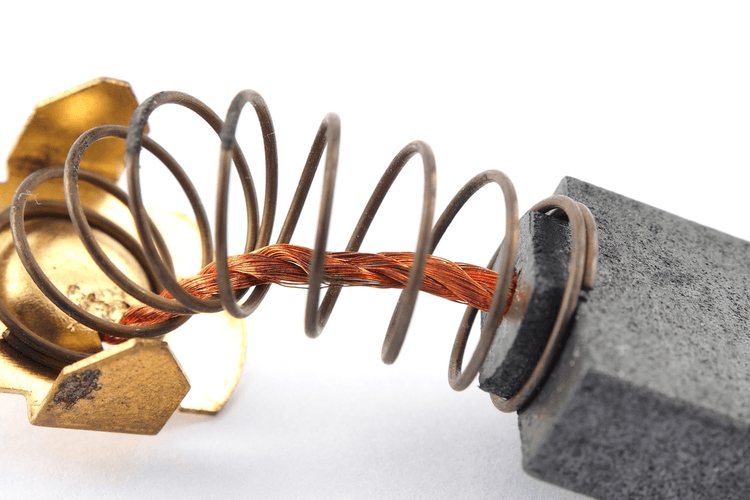
Carbon brushes, or electric motor brushes, play an important role in motors and generators, serving as electrical conductors. This is achieved by passing electrical current between the motor’s stationary and rotating wires. A carbon brush may have one or more carbon blocks and one or more shunts or terminals. There are often multiple carbon brushes in a motor or generator.
Different Grades of Carbon Brushes
Although the first brushes were made of copper, carbon eventually became the preferred motor brush material because of its high contact resistance, low friction, and ability to resist arcing.
Carbon brushes are divided into four brush grade families:
- Carbon graphites
- Electrographites
- Graphites
- Metal graphites
Carbon-Graphite Brush
One of the first carbon brushes, this is suitable for use on older, slower machines with maximum surface speeds of 4,000 feet per minute. This type of carbon brush is used in metal contacts and bases and is rarely seen in commutators because of the high friction it generates.
Electrographite Carbon Brush
Electrographite brushes are processed in high temperatures, making them longer-lasting and ideal for use in commutators. These brushes can be treated with organic or inorganic materials to make them more durable. This type of brush is ideal for use in a variety of operating environments, including those in which high temperatures and low humidity are the norms.
Graphite Carbon Brush
Characterized by layers of material, graphite brushes are made by binding either natural or artificial graphite with resin or pitch. These brushes are often used in commutators and slip rings. Their high densities and low porous qualities make them ideal for contaminated environments.
Metal Graphite Carbon Brush
Metal graphite brushes are made by combining graphite with fine metal powders such as copper, silver, tin, and lead. Due to their low resistivity, these brushes get used in myriad ways. They can be seen in forklift truck motors, battery chargers and welding generators, slip rings with high brush current densities, plating generators, and DC machines, and are often used as grounding brushes.
Maintaining Your Carbon Brushes
Equipment malfunctions are often attributed to carbon brush failures. Knowing how to properly maintain — and when to replace — carbon brushes is key to avoiding downtime.
When sparking occurs, or if there is another problem with the brush, the following carbon brush maintenance procedures are recommended:
- Confirm there is no obvious damage or dirt on the brush.
- Ensure that the brushes are able to move in their holders.
- Check the springs of each brush and adjust the pressure accordingly.
- Inspect the commutator for signs of mica, fins, and/or slugs.
- Make sure there are no blackened, pitted, or burned segments in the commutators.
- Look for roundness and bar-to-bar deviations in the commutators.
- Establish that the risers are properly connected.
- Check the brush drop or field-form curve of a machine running at normal load.
- See if the brushes vibrate by holding a piece of insulating material on top of the brush.
- Make certain that the bearings are not vibrating excessively.
Regular cleaning of motors with an air compressor will help avoid the development of many of these issues. If the above procedures have been performed and you still haven’t resolved the problem, contact the carbon brush manufacturer or your distributor. Service or replacement of your brushes may be required.
Proper Preventative Maintenance
Although sometimes easy to overlook, carbon brushes are one of the most critical components of motors and generators. Without brushes, motors and generators could not conduct electricity — and thus, could not function.
Make sure you’re not brushing off motor maintenance. Proper motor checks and cleaning should significantly extend the life of your carbon brushes and help you avoid any significant carbon brush maintenance problems.
Resources:
-
https://www.renown-electric.com/blog/how-it-works-carbon-brush-operation/
-
https://www.helwigcarbon.com/assets/files/pdf/Articles/ta1_96_2013%20brushes_sprkng_mach%20maint%20single%20pages.pdf
-
http://www.argointl.com/wp-content/uploads/2014/03/necp-How_to_Select_Brushes_for_Motors_and_Generators2.pdf
Image Credit: Shutter Baby photo/Shutterstock.com