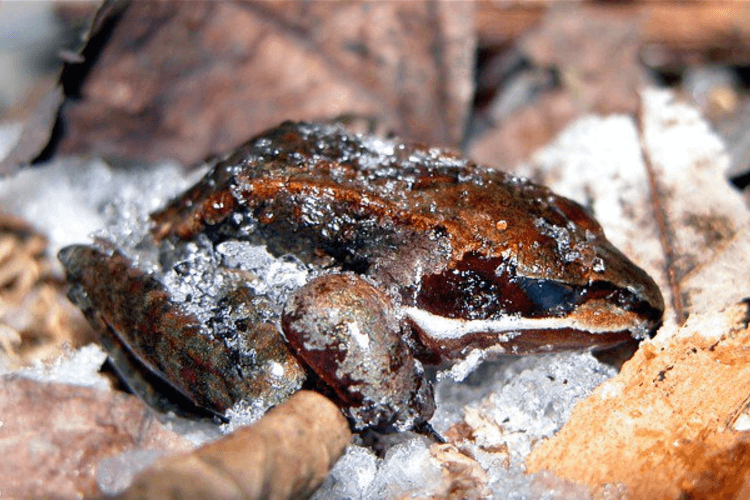
While every winter you may consider traveling somewhere warm to avoid the cold weather or staying inside and hibernating like many species native to cold winters, the North American Wood Frog will welcome the cold with open arms. The amphibian gradually lets up to 65% of its body completely freeze for the winter months.
The outside of the frog appears completely solid in this state, but it’s not dead. When the ice starts to thaw, so will the frog; its heart will restart and the frog will hop away without batting an eye.
According to research conducted at Carleton University in Ottawa, Canada, the frog’s blood contains special nucleating proteins that cause water to freeze first. This is ordinarily the problem with freezing living species — because water is the first liquid to freeze it causes cell dehydration — as it damages an animal’s organs. However, the Wood Frog’s liver reacts to this process by creating an excess of glucose — your body’s natural sugar — to prevent additional water from dehydrating cells. As a result, the frog never freezes on a cellular level despite appearing frozen from the outside.
This reanimation process, which is unique to this species of frog, has both stumped and amazed scientists for years. Researchers are investigating this survival technique for various medical applications, including cryogenics and the preservation of organs during transplant. Medical professionals hope to copy these freezing abilities to potentially add days to the preservation of human organs. Depending on the organ, mere hours can revolutionize organ transplants; a human heart lasts a mere four hours with current preservation processes.
A recent experiment conducted at the University of California used a similar process. Professor Boris Rubinsky removed a rat’s liver and filled it with glycerol, a similar sugar to glucose. He then froze the liver, thawed it, and transplanted it into another rat, proving the hypothesis a success.
The frog’s unique capabilities have also brought to light the science-fiction ideology of deep-freezing an entire human body and reanimating it decades later, comparable to the rumors that have spread about Walt Disney’s body after his death. However, scientists don’t believe the research for this technology has immediate potential; the frogs only stay frozen for months at a time.
Medical researchers are also still stumped by a very important step in the reanimation process: they have yet to determine how the wood frog triggers its heart to restart after being frozen.








![Is Automation a Threat or a Solution? Exploring How Americans See Automation in the Workplace [Reports]](https://machinerys.net/upload/cache/202507/is-automation-a-threat-or-a-solution-exploring-how-americans-see-automation-in-the-workplace-reports.webp)