
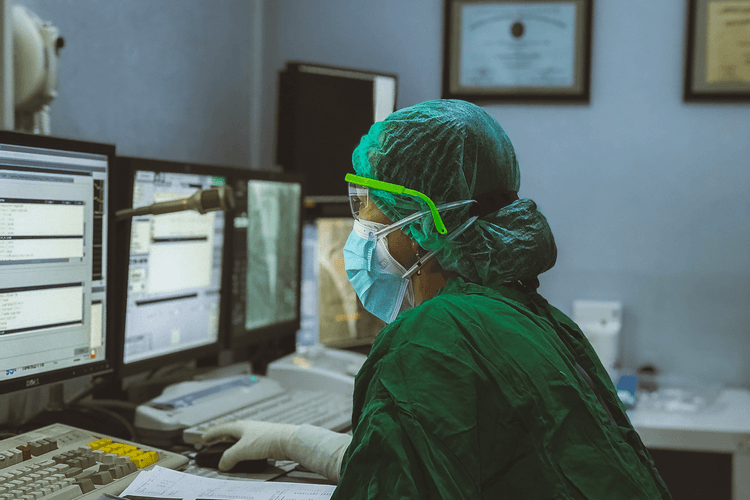
The use of artificial intelligence (AI) in healthcare will soon be the norm. But while these technological advancements are certainly remarkable and look set to revolutionize patient care, some are wary of the dangers.
How is AI currently being used to assist medical professionals, and are people right to be concerned?
AI has been present in the healthcare industry for several years. In 2016, a team of scientists at Harvard University developed an AI program that could identify breast cancer cells. There’s an app called mGene, which measures the faces of infants to detect rare genetic conditions with 90% accuracy. Meanwhile, a study between Facebook and a New York University professor is looking into ways that AI could help doctors better interpret MRI images.
But in the wake of the COVID-19 pandemic, interest and investments in medical technology have grown exponentially, leading to accelerated digital transformation.
Telemedicine services, for example, are now expected to grow sevenfold by 2025. Other developments have included the 3D printing of medical equipment and solutions that are capable of monitoring patients in real-time. AI-enabled voice technology is making healthcare easier than ever at home.
A team of researchers at the UC San Diego health system are one of several across the U.S. that are using AI to diagnose COVID-19. The team’s machine-learning program analyzes millions of pieces of data to help doctors identify which patients are at the highest risk of life-threatening complications and which can be referred to lower-intensity care.
Why Are People Worried About AI in Healthcare?
People are most concerned at the prospect of AI replacing physicians altogether. The thought that a robot might one day do everything from delivering an advanced consultation to deciding on an appropriate course of treatment is an alarming one, and people are quite right to question whether a machine could ever replace the intimacy of face-to-face care with a human doctor.
In reality, this is unlikely to be the case, and AI will serve to augment the doctor’s role rather than usurp it. Technology has the potential to provide additional and accurate knowledge and expertise, analyze vast swathes of patient data, improve efficiency in hospitals by triaging patients, reduce cases of misdiagnosis, and ultimately help the healthcare industry provide better patient care.