![How the Brooklyn Navy Yard Evolved into a Hub for Manufacturers [A Byte Out of the Big Apple]](/upload/20250615/zo3vrua2nf4.jpeg)
A Byte Out of the Big Apple

New York City attracts captains of industry, innovators, and creatives. It’s home to iconic skyscrapers and intricate subway tunnels, the neon lights of Times Square and delicate flora of Central Park, brick-and-mortar shops and dotcoms — and they’re all driven by the manufacturing industry.
Join Thomas Insights Executive Editor Stephanie Nikolopoulos as she takes a "byte” out of the history and future of the Big Apple in this monthly column.
“Turn left at the anchors,” my mother said, giving directions to our house over the phone.
The two large ship anchors flanking the top of our suburban New Jersey driveway were hard to miss. They were more than just a marker for our house, though — they were markers of our identity. We were the family of a sea captain.
When my father retired to Greece, he donated the anchors to the New Jersey town I’d grown up in. It’s been years since I’ve been back to my hometown, and I doubt most people living there today know the story of how the anchors got to the center of the town. Their purpose has changed: they no longer are markers of our house or of us — they are markers in the town.
A lot of New York is like that too. History is everywhere, but as the city has changed so have uses for its landmarks. Take, for instance, the Brooklyn Navy Yard.
As its name suggests, the Brooklyn Navy Yard originated as the dock that launched fighting ships. Today, though, more than 450 businesses have set up shop there, bringing in more than $2.5 billion each year for the city.
But with the U.S. Navy still integral to defending our freedom and preserving our economic prosperity, why did the Brooklyn Navy Yard evolve into an urban manufacturing oasis?
From Clam Beds to Prison Ships: The Early History of Wallabout Bay
Situated along the East River, between the present-day Manhattan Bridge and the Williamsburg Bridge, the Brooklyn Navy Yard has long attracted tradespeople, innovators, and creators. It is, after all, a location rich in clams and fish and directly across from Manhattan.
The Lenape were the first people known to discover the region. Because it’s flat, and therefore did not offer protection from intruders, the Indigenous people likely did not build campsites there. However, it may have served as a good source for gathering shells, which they used as currency with the European immigrants that arrived.
In the early 1600s, immigrants from Wallonia, a region of Belgium, settled there. When the Dutch arrived, they named it “Waal bocht,” meaning “Walloons’ Bend,” after the Walloons, and today we still call this historic district Wallabout Bay.
In 1637 Joris Jansen de Rapelje, a Dutch settler, purchased 335 acres of the land from the Lenape people. Today, a copy of the deed hangs on the wall of the Brooklyn Navy Yard Center at Building 92, which is a museum.
When the American Revolution (1776-1783) broke out, the British anchored their warships in Wallabout Bay. When they captured Americans who had defected from the British Crown, they would imprison them on these ships. About 11,000 people died on these prison ships. The most notorious of them was the HMS Jersey — which came to be called “Hell.” Today, there is a memorial for these prisoners of war called the Prison Ship Martyr’s Monument in Fort Greene, Brooklyn.
The Navy Yard Is Born
John Adams had “led the movement for independence” for the United States from England. During his service as America’s second president, he understood the impact the French and Indian War (1754-1763), a conflict between France and England over land in the New World, could have on the fledgling country. He, therefore, authorized the building of the Brooklyn Navy Yard, along with four other Navy shipyards.
The first building associated with the Brooklyn Navy Yard was built in 1806. It was the Commandant’s House.
The first responsibility taken in the Navy Yard’s own historical timeline is: “From 1820 to 1861, U.S. Navy squadrons serve to suppress the trade [of slaves] off the coast of Africa.”
A little over a century after the Revolutionary War, the Americans and the British united to establish the first undersea telegraph cable. The Brooklyn Navy Yard-built USS Niagara met the British HMS Agamemnon in the middle of the Atlantic Ocean to lay the cable. On August 5, 1858, Queen Victoria transmitted the first Morse Code message to the United States.
Speaking of communication achievements, in 1907, the first song ever broadcast over wireless radio occurred at the Brooklyn Navy Yard. Onboard the USS Dolphin, the arc radiotelephones of Dr. Lee DeForest were put to a fun little test when Eugenia Farrar, an opera singer, sang “I Love You Truly.”
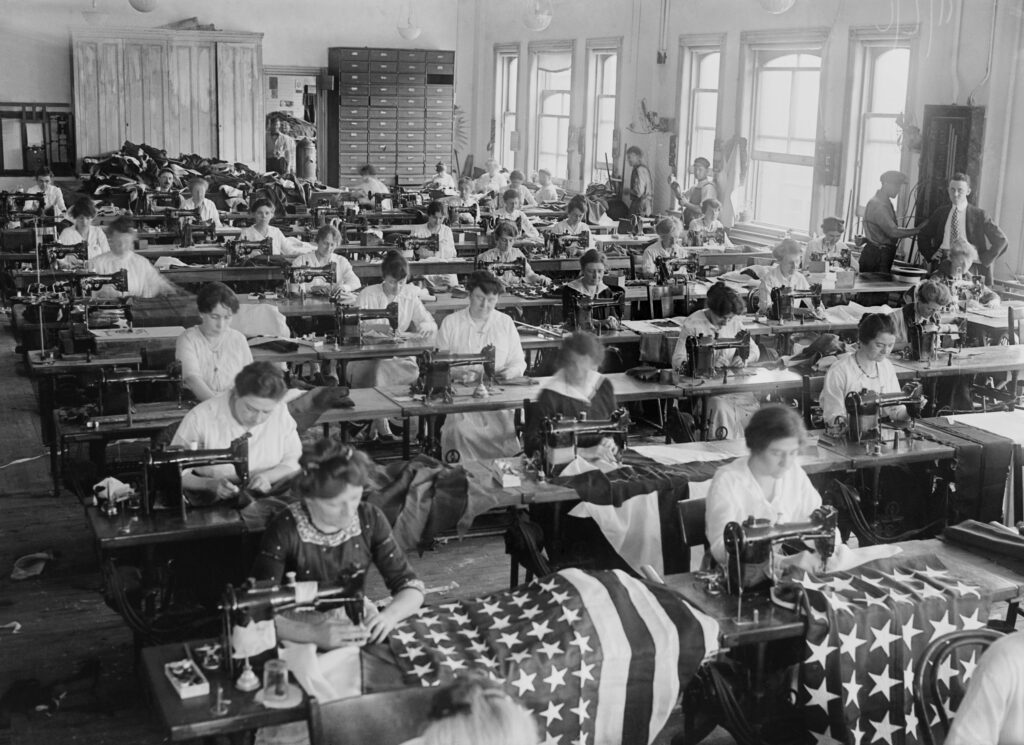
Women manufacturing American flags at the Brooklyn Navy Yard. Image courtesy of Everett Collection / Shutterstock.com.
Brooklyn Navy Yard During World War II
The Brooklyn Navy Yard is perhaps most associated with its connection to World War II. During the years of 1939 to 1945, there was tremendous growth at the Yard as a result of the need for vessels. This led to an explosion of job opportunities.
The U.S. government annexed the country’s second-largest produce market for its land. This doubled the size of the Brooklyn Navy Yard. Thanks to the added space, it was able to build the largest dry docks and crane in the world.
Amid the critical need for naval support, the Yard bolstered its workforce. During this era, the workforce reached 70,000 employees.
With many men serving in the war, the Yard began hiring its first female employees for skilled trades work outside of flag manufacturing. More than 4,000 women served a wide variety of roles from mechanics to crane operators and welders. The iconic Rosie the Riveter image grew out of the integral role women played in wartime production.
Additionally, the Fair Employment Practices Act of 1941 led to Black Americans being hired to work in the defense industry. However, most of the positions they were hired for at the Brooklyn Navy Yard were unskilled positions.
Brooklyn Navy Yard Shipbuilding History
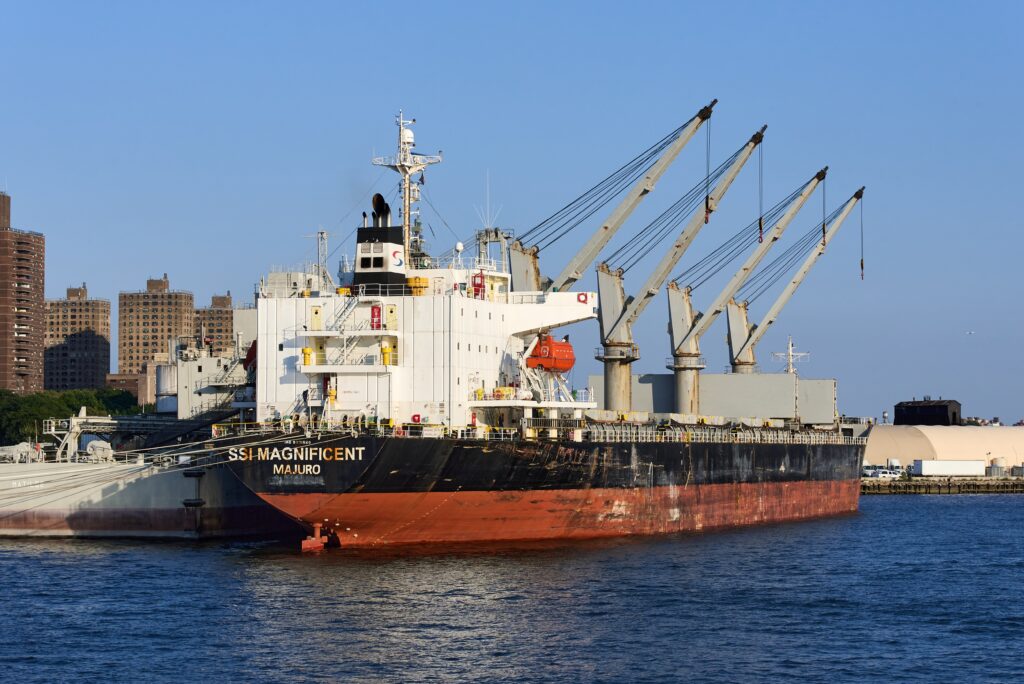
The SSI Magnificent, a cargo ship (not built at the Brooklyn Navy Yard), at the Brooklyn Navy Yard (ca. 2021). Image courtesy of John Penney / Shutterstock.com.
Many iconic ships were built or launched at the Brooklyn Navy Yard. The Brooklyn Navy Yard began manufacturing ships by 1820. Early ships include the USS Decatur, Dolphin, Fulton II, Niagara, Ohio, Peacock, San Jacinto, Savannah, and Vincennes.
In 1837, the Futlon II was launched. The 9-gun side-wheel steamer was the first U.S. steam warship appointed to sea duty.
In nearby Greenpoint, Brooklyn, the USS Monitor was built, and it came to the Brooklyn Navy Yard in 1862 to be outfitted. This was the first ironclad warship that the Union Navy commissioned, and as such, it was involved in the first battle between armored warships when it went up against the CSS Virginia during the Battle at Hampton Roads on March 8-9, 1862, during the Civil War. As the American Battlefield Trust put it: “Few ships in American naval history have been so highly acclaimed as USS Monitor, a vessel that transformed naval warfare with its revolving turret.”
Meanwhile, over in New Jersey, about a decade after that, a submarine prototype was being built to oppose the CSS Hunley and Pioneer during the Civil War. “The Intelligent Whale” — Halstead’s Folly — used compressed air to allow it to stay underwater for 10 hours; however, it eventually flooded. Owned by the Navy, the failed submarine was put on display at the Brooklyn Navy Yard until 1968; now, it is back home in New Jersey.
One of the most important ships in American history, the USS Maine, was launched from the Brooklyn Navy Yard. Its creation in 1889 ushered in the battleship era. During the Spanish-American War in 1898, it sunk due to an explosion.
Ever wonder what established the United States as a global superpower? Some say it’s when the USS Connecticut, which was built at the Brooklyn Navy Yard, began sailing as the flagship of President Teddy Roosevelt’s Great White Fleet. It went on a two-year tour from 1907 to 1909.
The United States’ military preeminence continued to grow in the years that followed, and a ship built at the Brooklyn Navy Yard played an important role in World War II. The war came to a close when Japan signed its surrender on September 2, 1945, aboard the USS Missouri. Today, tourists can step aboard the battleship, which is located at Pearl Harbor, Hawai’i, which is considered “in the top 10% of attractions worldwide.”
The last ship built at the Brooklyn Navy Yard was the USS Duluth, an Austin Class Amphibious Transport Dock that was commissioned on December 8, 1965. It served in the evacuation of Saigon during the Vietnam War, the 1983 Civil War in Lebanon, the 1989 Exxon Valdez Oil Spill, and the 1994 evacuation of Somalia. In 2013, it was sold for scrap.
Why the Brooklyn Navy Yard Closed
During the Korean War, the Brooklyn Navy Yard employed 20,000 workers. This helped buoy America’s naval prowess.
However, the Yard was beginning to experience a decline around this time. In 1960, a forklift accident resulted in a fire that led to 50 lives being lost, 323 people injured, and $75 million in repairs.
Additionally, the Brooklyn Navy Yard was no longer considered technologically advanced. Large ships built elsewhere couldn’t even dock there because they did not fit under the famous bridges in the area.
In 1966, Secretary of Defense Robert McNamara closed more than 90 military installations and bases — including the Brooklyn Navy Yard. At the time, it had been New York’s longest continually active industrial plant.
Brooklyn Navy Yard Reemerges as an Industrial Park
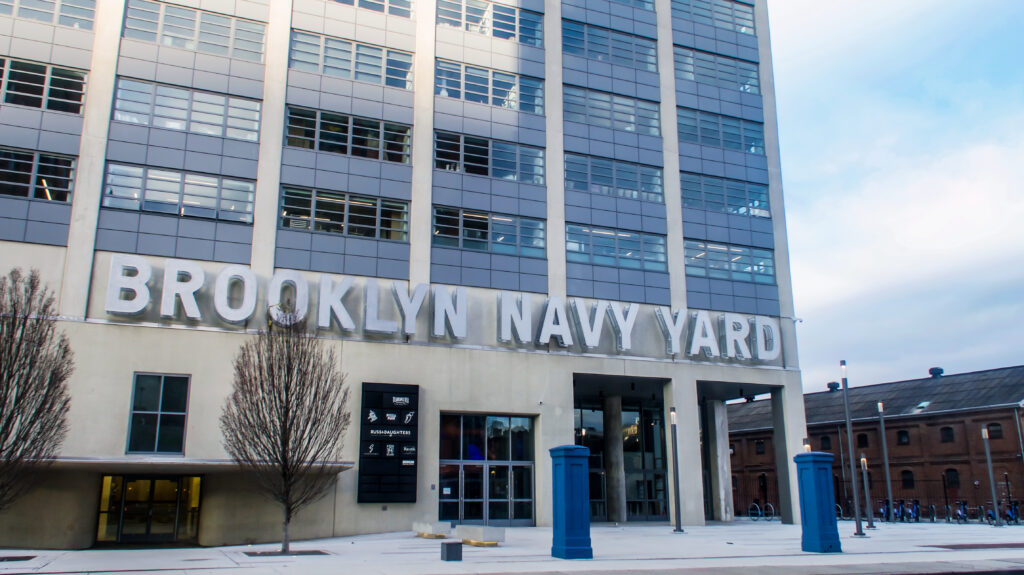
Front entrance of the Brooklyn Navy Yard. Image courtesy of Edwin Cabral / Shutterstock.com.
For a century and a half, it had created jobs. When the Brooklyn Navy Yard was shut down, upwards of 9,000 people lost their jobs.
To fill the vacuum, New York City brought on Commerce, Labor and Industry in the County of Kings (CLICK) to run the Yard as an industrial park in 1969. When that failed to secure employment, the Brooklyn Navy Yard Development Corporation (BNYDC) replaced them in 1981. BNYDC began diversifying its tenants to no longer just include the shipping industry. By 1998, there were more than 200 small- to mid-sized businesses (SMBs) that employed about 3,000 people.
From 2001 to 2011, the Yard saw rapid growth under the direction of BNYDC. Significant upgrades were made to its infrastructure, and it was expanded. While the number of businesses only grew a little more to 275, the number of employees working there nearly doubled.
When the 310,000-square-foot Steiner Studios opened in the Yard in November 2004, it was reported to be the ”largest and most sophisticated studio complex outside of Hollywood.” The size was later doubled.
Then, in 2011-2018, Brooklyn Grange opened as the country’s largest rooftop farm. Several other green manufacturing facilities were also built in this time period.
In 2017, $700 million was put into new development of the Yard.
Brooklyn Navy Yard Today
One of our nation’s most influential shipyards has repurposed itself as a 300-acre economic hub with more than 5 million square feet under its roof. Today, it employs 11,000 workers and counting.
Brooklyn Navy Yard Companies
The Brooklyn Navy Yard “anchors New York City’s modern industrial sector and its businesses.” It does so by supporting small manufacturing tenants, particularly with a bent toward production, technology, and artisanal.
A cross-section of its 450+ businesses includes:
- 5TEN, which provides innovative LED technology solutions.
- Agger Fish Corp, an import-exporter of marine products.
- Ares Printing & Packaging, which houses New York’s two largest sheet-fed printing presses and manufactures paperboard, POP displays, and folding cartons.
- Bednark Studio, a full-service fabrication company.
- Brooklyn Roasting Company, which sources, roasts, and brews sustainable coffee.
- Honeybee Robotics, which builds robotic systems and was acquired by Blue Origin.
- Nanov Display, Inc., which manufactures outdoor Smartcities kiosks and digital signage.
- Ponto Care, a medical exam delivery service.
- Tarform, which manufactures electric motorcycles.
You can see the full list of Brooklyn Navy Yard businesses here. There, you can read their fascinating and inspirational stories.
Brooklyn Navy Yard Events
You don’t need to work at the Brooklyn Navy Yard to visit. It offers a variety of opportunities for tourists and New Yorkers alike. There’s shopping, dining, art exhibitions and installations, entertainment, education, and events.
In Building 92, there’s a permanent exhibition entitled Brooklyn Navy Yard: Past Present, and Future. Here you can learn more about the site’s history.
Occasionally, there are design open studios, programs on Design Principals for Urban Landscapes, distillery tours, conferences, and yoga sessions. You can find out about Brooklyn Navy Yard events here.
Professional groups can even request private tours. On the tours, groups learn about the Yard’s economic model, urban manufacturing, and public-private partnerships, among other topics. There is also programming for schoolchildren and college students.
Getting There: Brooklyn Navy Yard Address
Because of its massive size and numerous buildings, there’s no one exact address for the Brooklyn Navy Yard. However, these two addresses may help:
- General Address: 63 Flushing Avenue
- Brooklyn Navy Yard Development Corporation: 141 Flushing Avenue, Building 77, Suite 801
There are gate entrances at:
- Sands Street (and Navy Street)
- Cumberland Street (and Flushing Avenue)
- Clinton Avenue (and Flushing Avenue)
- Clymer Street (and Kent Avenue)
- Market Street
The Yard is accessible by car, bicycle, and multiple public transportation options, including subway, bus, and ferry.
Get detailed direction information and hours here.
Take Another Byte Out of the Big Apple
- The Floating Warehouse Now Docked on the Street of Ships
- What Little Island Has to Do with the Titanic
- The Unbelievable Story of How the Brooklyn Bridge Was Built