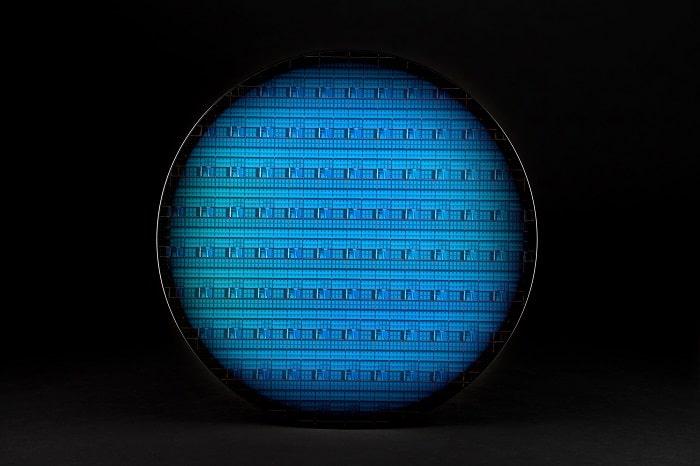
Intel’s 300mm silicon spin qubit wafer. Image credit:Intel/Businesswire
In a giant step towards the development of scalable silicon-based quantum processors, leading American multinational technology company,Intel, released theresultsof its groundbreakingresearchinto controlling and standardizing single-electron spin qubits.
Qubits, or quantum bits, are the quantum version of classical bits, but they have the ability to store and process information in a much more complex and powerful way, thanks to “superposition” and “entanglement” properties.
Quantum Bits (Qubits)
In quantum computing, qubits are the basic units of quantum information. In contrast with regular computer bits that store information in either 0 or 1, qubits can be either, or both at the same time, thanks to “superposition” (although they collapse to a definite state when measured).
This allows them to represent and process a lot more information simultaneously. Qubits can be linked in a way that classical bits cannot. Via “entanglement”, no matter how far apart they are, the state of one qubit can instantly affect that of another, allowing efficient and swift communication between them.
Intel’s Qubit Research
Intel’s research paper, published byNatureon May 1, 2024, shows how high qubit control fidelity and uniformity are imperative for building reliable quantum computers. The study was conducted by Intel’s quantum hardware researchers who created a 300mm cryogenic probing process allowing them to collect a lot of data on spin qubit devices on complete wafers.
With techniques used in the manufacturing of metal oxide semiconductors (CMOS), the researchers were able to get a larger amount of data so they could adequately analyze consistency. They also found that the wafers’ single-electron devices performed impressively when used as spin qubits. This achieved a 99.9% gate fidelity—the highest ever reported for CMOS-derived qubits.
Spin Qubits
Just like all bourbons are whiskeys, but not all whiskeys are bourbons, all spin qubits are qubits, but not all qubits are spin qubits (that’s quite the tongue-twister!). Spin qubits rely on the spin of individual electrons, and store quantum information in the spin state of an electron (either "up” or "down”).
They’re used in semiconductor materials (i.e., silicon) and other solid-state systems. At around 100 nanometers in diameter, spin qubits are smaller and denser than other types of qubits (i.e., superconducting qubits), and can maintain their quantum state for longer.
Intel managed to cram all this ability into such a small package using extreme ultraviolet (EUV) lithography. This, along with the fact that they can be made using existing semiconductor manufacturing technology, makes spin qubits appealing for use in quantum computers.
Intel’s Silicon-Based Quantum Processors—Conclusion
Marking a significant advancement in scalable quantum computing, Intel’s research focuses on controlling single-electron spin qubits. Relying on the spin of electrons, spin qubits are smaller in size than other types, have longer coherence times, and are compatible with existing semiconductor manufacturing processes.
This important research yielded impressive results, achieving 99.9% gate fidelity, an important crucial step towards the manufacturing of reliable quantum computers.