Ask anyone who’s ever worked inside a meat processing plant and they’ll confirm that the work is both labor-intensive and dangerous. In recent months, it’s also become clear that working conditions within these plants create a perfect storm for the spread of disease.
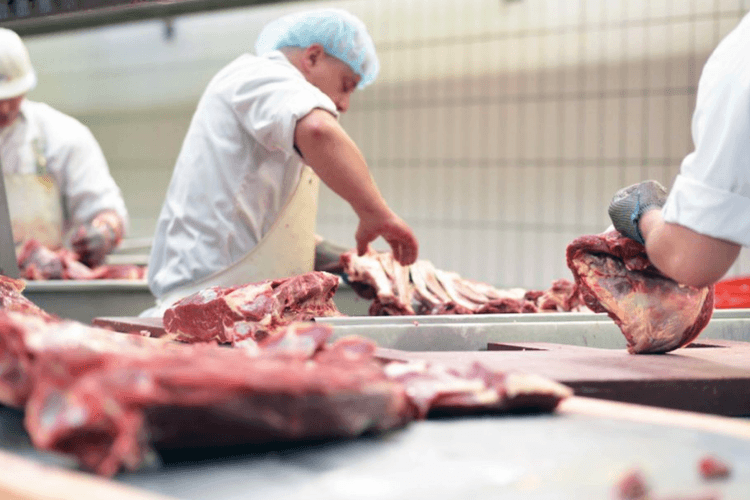
Employees typically work long shifts where they stand shoulder-to-shoulder with their colleagues along an enclosed, and often crowded, production line. The tasks they perform are repetitive and hands-on. Protective clothing and hairnets must be worn, which make for a sweaty day’s work.
Meat processing plants have emerged as COVID-19 hot spots in the U.S., Canada, Australia, Brazil, and Europe. The solution lies in automation, but will robot butchers become available in time to slow infection rates?
The Impact of COVID-19 on the U.S. Meat Industry
In June, CNBC reported that more than 20,000 meat processing plant workers had fallen ill, 91 have died, and dozens of plants were forced to shut down altogether. The Centers for Disease Control and Prevention (CDC) reported that 9% of workers at meat and poultry processing facilities have been diagnosed with the coronavirus.
As a result, wholesale meat prices have rocketed while livestock prices have plummeted. It’s expected that the $213 billion U.S. meat industry could face losses of more than $20 billion in 2020.
In April, the Trump administration invoked the Defense Production Act, which classified meat production plants as essential. This has ensured plants remain open while protecting employers from legal liability if their employees fall sick.
How Is the Meat Industry Responding to COVID-19?
Meatpackers have invested in additional safety measures including personal protective equipment (PPE), thermal scanners, and partitions between workers.
JBS, for example, implemented measures such as daily deep-cleaning, staggered shifts for employees, and plexiglass dividers, as well as relaxing its attendance policies. Smithfield Foods has installed new hand sanitizing stations, provided additional PPE, and is carrying out temperature checks for all employees.
But is it enough?
Automation in Meat Processing Plants
The adoption of automation in meat manufacturing has been comparatively slow, largely because it has proven difficult to develop robots that can effectively and accurately perform the work of human plant workers. This is exemplified by the fact that meat processing plants employ 3.2 workers per 1,000 square feet of manufacturing space. According to research conducted by BCG, this is three times the national average for manufacturers across all industries. In recent years, several automation projects within meatpacking companies have been abandoned altogether due to increased wastage of high-value meat.
Designing a robot that can debone or disassemble carcasses of all shapes and sizes with minimal waste, perform intricate tasks such as trimming fat, and identify different shades of color within flesh is a challenge, but it’s one that meatpacking giant Tyson Foods is hoping to meet — especially in the wake of the coronavirus pandemic.
Tyson Food currently employs 122,000 people to produce as much as one-fifth of the U.S.’ chicken, beef, and pork. To date, Tyson’s investments in technology and automation are valued at $500 million, but CEO Noel White recently commented that the coronavirus pandemic is catalyzing the company’s commitment to the automation of its processes. At its Manufacturing Automation Center, the company is in the process of developing a robot butcher to automate its deboning system.
Technicians at the Automation Center have been teaching machines to recognize subtle nuances in the coloration and shape of meat. According to the Wall Street Journal, a water-jet cutting system has been designed, which can carve chicken breasts with more precision than human workers.
Tyson Foods isn’t the only meatpacker turning to automation. Pilgrim’s Pride, the second-biggest chicken processor in the U.S., has developed deboning machines that fall behind human output by only 1% to 1.5% in terms of meat yield per chicken.
How Will Automation in Meat Processing Plants Impact Jobs?
Meatpacking work was undesirable long before the COVID-19 pandemic came along. The Bureau of Labor Statistics lists meat processing as one of the more hazardous jobs in the U.S. economy, with the rate of workplace injury or illness more than 40% higher than the national average.
It will take time, perhaps years, before robot butchers replace any significant number of employees. In the meantime, employers can look to reskilling their workforce to fill more advanced roles. It’s an opportunity to bridge the digital skills gap and advance Industry 4.0.
Related Stories from Thomas
- Is Tyson doing any better navigating COVID-19? It cited progress.
- Here are 12 ways COVID-19 is impacting supermarkets. (Including a warning to carnivores.)
- Is your company moving toward automation? Here are 3 tips on how to close the digital skills gap.