Since the outbreak of the COVID-19 pandemic, reports of test shortages across the globe have saturated the news.
Back in May, states grappled to obtain nasal swabs required for the most common coronavirus test, making it impossible for states across the U.S. to keep up with testing demands.
Even now, several states are experiencing major backlogs in their coronavirus testing efforts. Pipette tips, which are used to precisely transfer liquid between vials during the processing of tests, are currently in short supply. Meanwhile, queues at coronavirus test centers have snaked around entire city blocks, residents have been forced to wait in cars for as much as eight hours, and some testing facilities have run out of tests within minutes of opening their doors to the public. As of the end of July, U.S. labs are running approximately 800,000 tests per day, of the estimated 6-10 million tests needed to contain the virus.
Could wearables be the solution to these ongoing challenges?
The Patch That Detects Early Coronavirus Symptoms
Wearable devices have proved beneficial in many areas of healthcare, ranging from the commercially available smartwatches that can track and record data such as sleep patterns, heart rate, or body temperature, to the more precise, clinical-grade wearables used at hospitals and clinics. In a bid to tackle the spread of coronavirus, scientists are currently exploring both types of wearables.
One such researcher is John Rogers, director of Northwestern University’s Querrey Simpson Institute for Bioelectronics, which is known for developing clinical-grade wearables including devices that can run electrocardiograms (EKGs) and monitor maternal and newborn health.
In recent months Rogers has expanded his technologies to develop a coronavirus-tracking patch device known as ADAM, alongside tech startup Sonica Health and Chicago’sShirley Ryan AbilityLab.
How Does ADAM Work?
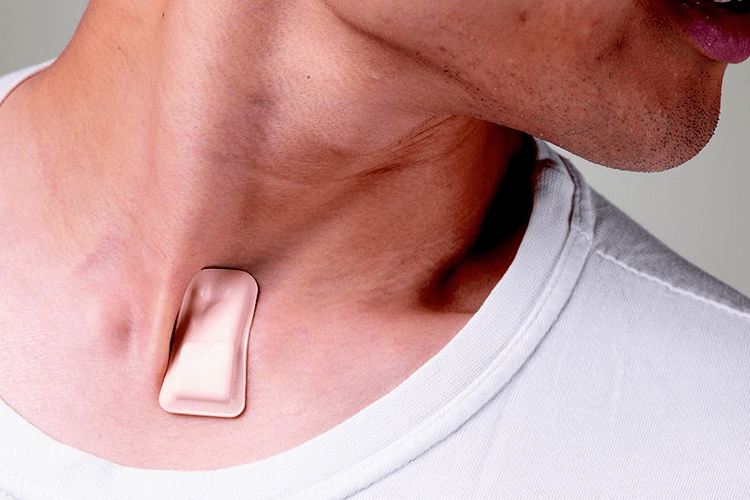
The rubber patch, which resembles a Band-Aid, was inspired by a wearable device designed by AbilityLab to rehabilitate stroke patients struggling with speech and swallowing.
The latest iteration of this device is designed to monitor coronavirus symptoms, functioning as a flexible wireless sensor that can identify and monitor the early symptoms of coronavirus and the progression of the illness.
The Journal of the American Medical Association has cited fever, cough, and shortness of breath as the main symptoms of coronavirus. By adhering to the wearer’s skin at the point where the throat and chest meet, the device can monitor each of these symptoms, measuring vibrations and biomarkers such as the sound and intensity of coughs and respiratory rate. Sitting close to the carotid artery, it can also collect blood flow signatures, which can be used to monitor the wearer’s heart rate, while pulse oximeters observe low blood oxygen levels.
Rogers told Smithsonian Magazine, “The device is recording continuously so there are no gaps in the data, and that turns out to be really important because what we’ve seen with several of these patients is they have very brief transitory periods of spikes in heart rate, for example.”
What Does the Future Hold for the ADAM Patch and Other Wearables?
The patches have recently been rolled out in a pilot study at AbilityLab and Chicago’s Northwestern Memorial Hospital with over 3,000 hours of data being collected.
Once a day, the wearer removes the patch and places it onto a wireless charger. At this point, all the data collected is transferred to an iPad and uploaded to an HIPPA-compliant cloud platform where an AI algorithm analyses it for coronavirus-related anomalies. Medical professionals can monitor changes and identify symptoms such as irregular respiratory behavior.
Alongside the monitoring of patients, the data is being used to further develop the device’s algorithms to identify more nuanced coronavirus symptoms, including specific stages of the disease. In the future, it will also have the ability to distinguish between specifics such as an asthma cough and a coronavirus cough.
In the coming months, the use of wearable devices to identify and track coronavirus symptoms is likely to increase. Fitbit, for example, has completed a study that shows there are fluctuations in a patient’s heart rate and respiration days before the typical coronavirus symptoms appear. NBA players are using the Oura ring to monitor heart rate and body temperature. When a certain threshold is reached, the player is sent to be tested for coronavirus.
It will take time and more extensive research before these wearable devices can be relied upon for accuracy, but the outlook is certainly promising.