The adoption of automation and robotics at Boeing hasn’t been a straightforward process.
For starters, the company is renowned for favoring pilot control over the integration of automated systems, placing trust in the skills of its human employees. The company’s faith in automation was badly shaken by the MCAS malfunction, which led to horrific plane crashes in Indonesia and Ethiopia.
In terms of manufacturing processes, the aviation industry as a whole has been slow to embrace automation. However, the pace of production is beginning to increase, and Boeing’s biggest rival, Airbus, was much quicker to pioneer new technologies.
1. Boeing’s Flex Tracks
Automated systems first appeared on Boeing’s assembly line back in 2013. Beforehand, the company’s airplanes were made almost exclusively by hand.
The Flex Track is an automated drilling system, which enables the company to manufacture its 777 more safely, efficiently, and flexibly. The track travels over the plane’s exterior to drill and countersink holes with much greater speed and accuracy than a human worker.
When the system was first implemented, Boeing registered an immediate 93% improvement in hole quality. Two years later, the Flex Track has eliminated 98% of defects, tool marks, and misaligned holes.
2. Boeing’s Fuselage Automated Upright Build (FAUB) Initiative
In November 2019, Boeing announced that it was abandoning one of its robotics systems that had been four years in the making.
The fuselage automated upright build (FAUB) was responsible for building two of the 777’s main fuselage sections, working in tandem with the Flex Track system to drill holes and fasten together metal panels. FAUB was designed by Kuka Systems to replace Boeing’s human workers who, at the time, were inserting 60,000 rivets into each plane by hand.
While the Flex Track remains in use, skilled mechanics will replace FAUB to manually insert the fasteners.
3. Boeing’s Robotic Painter
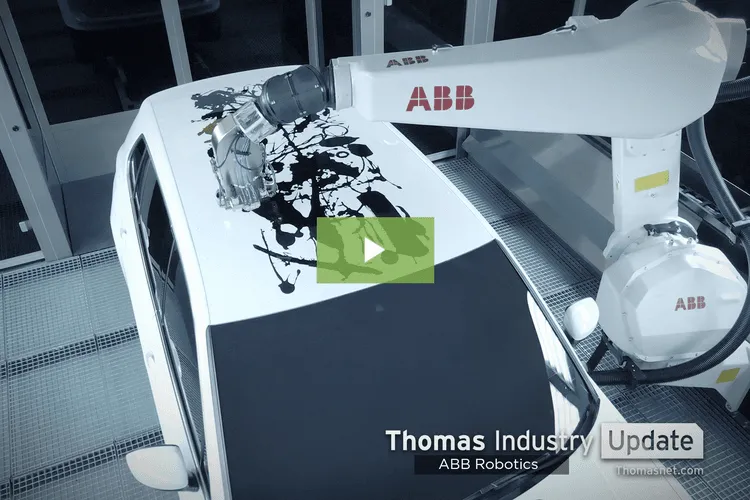
In 2013, Boeing implemented its first robotic painter to accelerate the production of its 777. The robotic system, which is called the Automated Spray Method (ASM), has a 19-axis mechanical arm with a reach of 18 feet. It sits in a sealed booth where it washes and paints the 106-foot wings of the aircraft. The robotic painter can finish a single coat in a mere 24 minutes, which would take human painters four hours. Boeing’s employees need only load and unload the paint and let the robotic painter do the rest.
4. Boeing’s Australian Co-bots
In 2008 Boeing established its advanced research and development unit in Australia. Since then, researchers at the unit have been experimenting with the use of collaborative robots, which share an overlapping workspace with a human operator. In 2017, Boeing integrated a Universal Robot UR10 into the existing assembly process of its 737 component production system. Since its installation, the co-bot has saved hundreds of hours of production time, while also protecting employees from repetitive strain injuries caused by ergonomically taxing labor.
5. Boeing’s Artificial Intelligence Solution
In 2019, Boeing reported that technologists in South Carolina were using artificial intelligence (AI) to drive assembly efficiency. The AI solution is being used to support fuselage section assemblies for the 787.
The company reported that the automated tech has saved around five hours of flow per assembly line through the creation of a predictive model. The team in South Carolina is hoping to use this technique to drive other predictive capabilities across the 787’s production line and ultimately apply the technology to other aircraft production programs.