What Is a Robot?
As Wikipedia explains straightforwardly, “a robot is a machine—especially one programmable by a computer—capable of carrying out a complex series of actions automatically. A robot can be guided by an external control device or the control may be embedded within.” Robots may be independent or semi-independent with a broad variety of applications ranging from industrial or medical settings to even microscopic use cases.
In a slightly more complicated way, ISO 8373:2012 defines an industrial robot as "an automatically controlled, reprogrammable, multipurpose manipulator, programmable in three or more axes, which can be either fixed or mobile for use in industrial automation application.”
We Know the Definition, But What About the Market?
Unless you are in the robot manufacturing or servicing business, you probably don’t think much about the overall robot market; You have enough things to worry about just within your own business and industry.
Years ago, I consulted in the area of Manufacturing Automation (MA) and learned a lot about robots. However, compared to today’s environment, what I did was basic. Now that servicing MA is a big business, I decided to take a look at the state of robotic applications and related business models.
What Are the Most Popular Industrial Robot Applications?
According to JABIL, a U.S.-based manufacturing services business, the most popular industrial robot applications include:
- Arc Welding: Having been around for more than 40 years, its main advantage is protecting employees from burns and hazardous fumes.
- Spot Welding: A quick and safe option.
- Materials Handling: This covers everything from pick & place to the autonomous devices used in warehouses and shipping areas. These robots don’t call in sick, need a bio break, or have to wear masks.
- Machine Tending: Designed to load and unload machines, they are ideal for the “lights-out factory.”
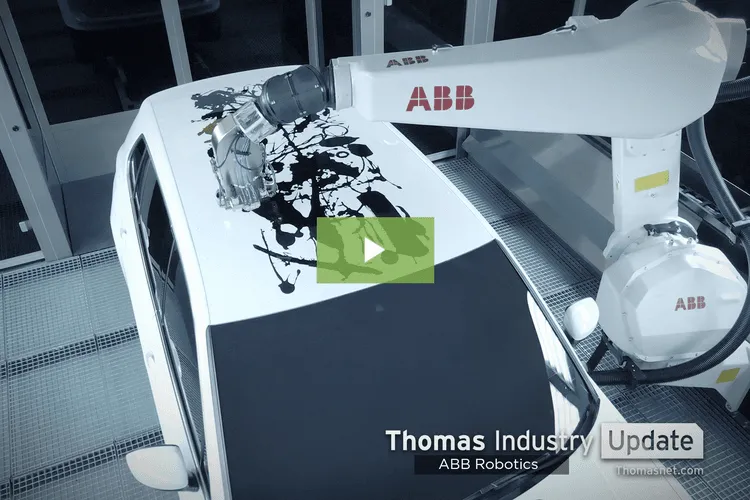
- Painting: Whether a quick color and product change or consistent product coverage, these robots allow automobile factories to produce different models in one building and send them all to a single paint shop that adapts to an ever-changing product mix.
- Pick, Pack, and Palletize: A fast, accurate, and flexible option, these robots can remove reject parts from a conveyor and fill candy boxes with pieces fed from multiple lines.
- Assembly: By building products either alone, with other robots, or through a mix of robots and humans, they do the heavy lifting and can get to the hard to reach places.
- Mechanical Finishing: These robots can handle anything from large parts coming off a multi-axis cutting machine to small parts requiring a precision fit and finish like a hip joint.
- Gluing and Other Chemical Attachments: These models offer high speed, accurate placement of adhesives on difficult to reach parts.
- Other Applications: These robots handle other applications not covered above, including inspection, building security, and other applications that meet the “dirty, dangerous, dull and demeaning” criteria.
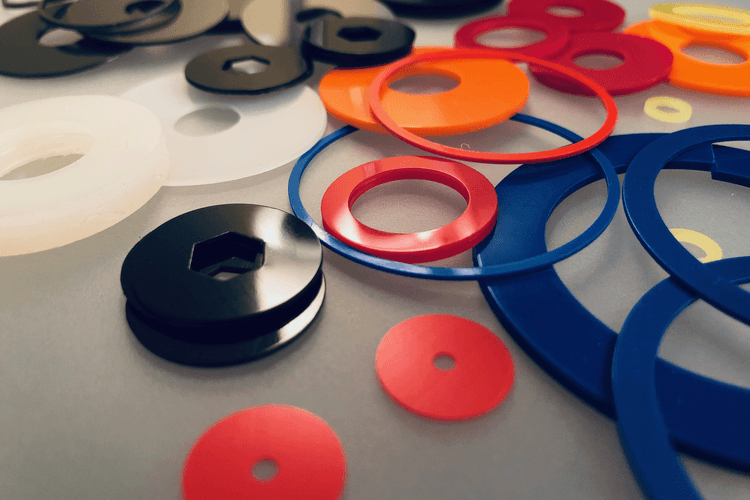
Of course, there are other areas that are newer than the established ones mentioned above — and they are especially interesting. One of the most intriguing applications I have seen is a small system suspended on four arms with a camera above the gripper. The equipment was programmed to sort colored plastic disks into small containers at a rate of what appeared to be about three seconds per item. The robot reached for an item, the camera identified the color, and then the gripper grabbed the disk and flipped it into the appropriate bin. I stood in front of it for a few minutes, amazed at how quick and accurate it was. And if could sort disks, it can sort medicine or screws or any small parts.
Another industrial application is the use of drones to confirm inventory levels, like checking lumber in a warehouse or counting boxes on a high storage unit. In addition to preventing stockouts, it can do continuous cycle counts to ensure inventory accuracy.
An Overview of the Global Industrial Robot Market
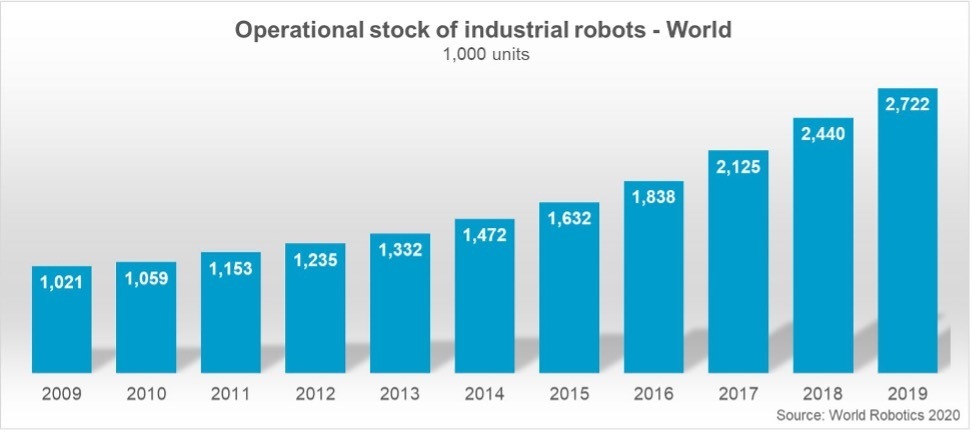
According to the World Robotic 2020 Industrial Robots report, 2.7 million industrial robots are currently operating in factories around the world. The largest number of installed robots in the three major industrial regions are:
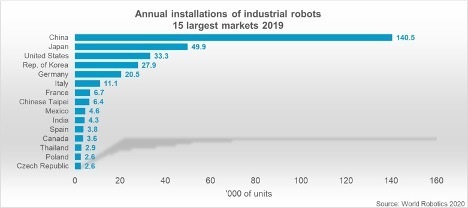
- Asia – China has 783,000 total robots
- Europe – Germany has 221,500 total robots
- Americas – The United States has 293,200 total robots
This chart shows the worldwide growth of industrial robots:
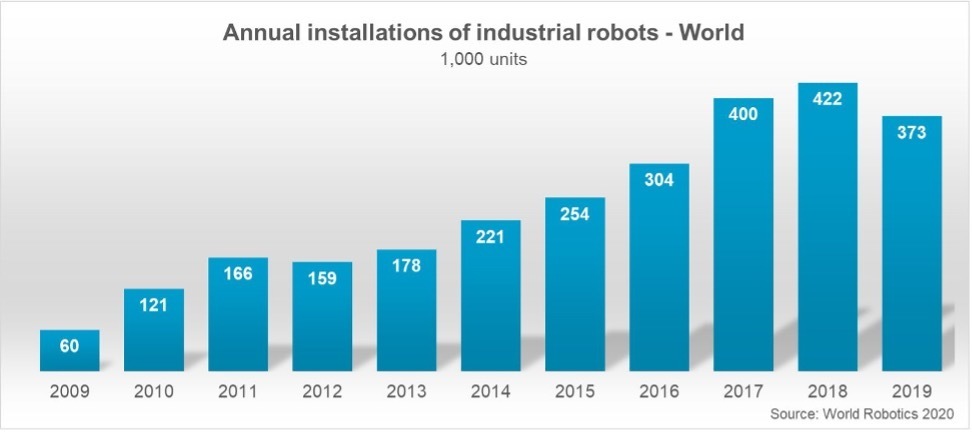
This chart illustrates the total number of industrial robots operating worldwide:
And lastly, here are the top 15 markets worldwide for industrial robots:
What Does This Mean for Your Business?
If you are in the business of manufacturing industrial robots, CONGRATULATIONS. Although the field has many players, there does not appear to be any reason why you should not prosper. And if you are thinking about purchasing your first robot or trying a robot for a new application, you have a large number of choices for a future robotics partner who understands the business and will minimize your risk.
One More (Fun) Thing…
First, watch this short video. Then ask yourself, “If Boston Dynamics, which was recently acquired by Hyundai, can create robots than can does these things, what can they and other robot manufacturers do for my manufacturing business?”