The thing that makes the sci-fi series Westworld so cool is its mind-bending combination of the Old West with futuristic robotic technology. What appears to be a grizzled old rancher sitting on his front porch is actually highly sophisticated AI following a complex set of protocols. Even the sheep and cattle are robots.
Perhaps this is why the invention of “robotic blacksmithing” is getting so much attention. Also known as metamorphic manufacturing, the process combines the attributes of a blacksmith with the dimensional control, process monitoring, and reproducibility of a machine.
What is Robotic Blacksmithing?
The process has been championed by Ohio State University’s professor of materials science and engineering Glenn Daehn, who also led the study team to produce a report from the Minerals, Metals & Materials Society (TMS) titled Metamorphic Manufacturing: Shaping the Future of On-Demand Components.
Daehn refers to metamorphic manufacturing as the third wave of manufacturing. The first wave, computer numerical controlled manufacturing (otherwise known as CNC machining, or subtractive manufacturing) is regarded by Daehn as time-consuming and wasteful because only a fraction of the material is used: sometimes as much of nine-tenths of a metal block is carved away. The second wave, 3D printing or additive manufacturing, also produces waste, and the cost of raw materials — metal powders — and equipment can be prohibitive.
The process is called “metamorphic” because it changes the properties of metals rather than adding to (3D printing) or subtracting from (CNC) the material. The robotic blacksmith evaluates the shape and microstructure of the material using sensors, heats the part with lasers to make it malleable, then shapes the part (incremental deformation) with the force of its robotic arms or interchangeable tools such as hammers.
Why Is the Machine Referred to as a Blacksmith?
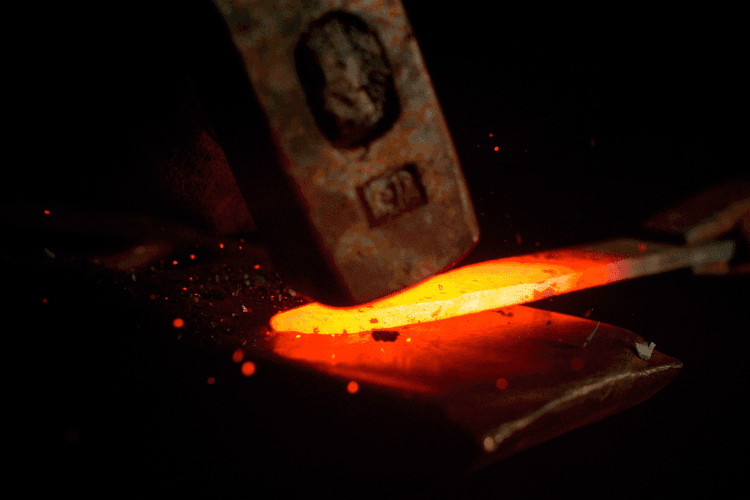
Because, as Daehn explains, blacksmiths were renowned for their skill and ingenuity in producing anything from intricate jewelry to armor and swords with remarkable properties. Robotic blacksmiths emulate the time-honored method of continual shaping and reheating to make the material malleable enough to work into any shape, much like the kneading of dough.
The drawback of human blacksmiths was their lack of consistency — two swords produced by the same smithy may look the same but prove to have radically different properties when tested in battle. By combining the attributes of a blacksmith with precision robotics, Daehn believes metamorphic manufacturing will be capable of making parts with highly reproducible properties and dimensional precision necessary for safety-critical applications such as aircraft parts.
Benefits of Robotic Blacksmithing
Metamorphic manufacturing has the ability to:
- Closely tailor materials like a blacksmith to enable flexible, on-demand manufacturing
- Reheat stubborn parts that would crack if stamped to make them malleable
- Better control the properties and geometry of a part
- Record data from the manufacturing process to create quality assurance
- Create complex shapes out of a single piece of material
- Avoid the need for joining through welding or brazing, removing the weakest part of a structure
- Work 24/7
- Save costs and time compared with closed-die forgings
- Create less waste, with a low environmental footprint
When Will Robotic Blacksmiths Be Available?
While there is no firm timeline for the third wave of manufacturing, Daehn laid out the path ahead in a short paper on the topic. He writes that there is work to be done on developing the machines that the robotic blacksmith will wield — hammers, rollers, etc. — as well as the optical monitoring and control systems that measure shape, temperature, and strains, along with integration into advanced closed-loop control systems and validation/verification protocols.
Will the future of manufacturing be metamorphic?
If the tech proves to be faster, cheaper, more environmentally sustainable and more reliable than subtractive and additive manufacturing, it’s very possible that robotic blacksmiths will one day supersede current technology used in industry.









![IIoT Spending to Jump 40% by 2024 [Report]](https://machinerys.net/upload/cache/202507/iiot-spending-to-jump-40-by-2024-report.webp)