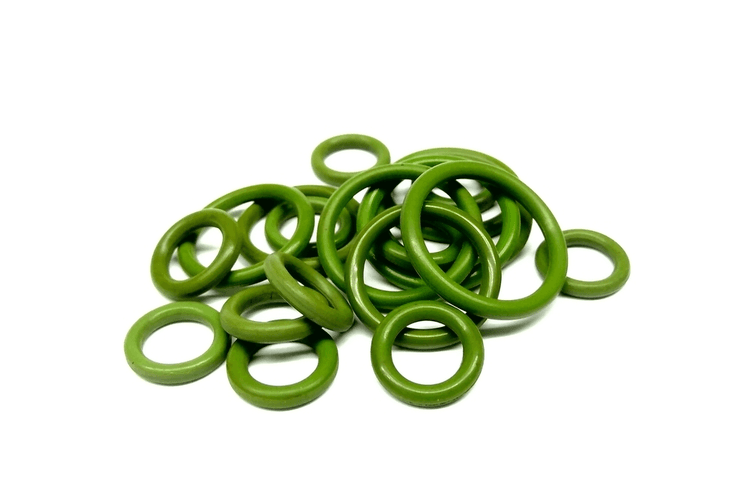
Fluoroelastomers, commonly known as FKM or by the brand name Viton©, play a key role in applications requiring high-temperature properties and optimal chemical resistance.
Capable of performing in environments with temperatures of 392 °F (200 °C) and higher, molded components such as FKM O-rings and Viton© shaft seals are able to maintain stability and resist attacks from chemicals and petroleum-based oils. Introduced in 1957, FKM Viton© was developed by DuPont for the aerospace industry to address the need for a high-performance elastomer that could withstand harsh operating environments.
Types and Properties of FKM
Made from copolymers of vinylidene fluoride and hexafluoropropylene, an array of FKM classes have been developed, each featuring different chemical compositions, fluorine contents, and crosslinking mechanisms to address different application requirements. The higher the fluorine content, the higher the resistance to various fluids. The five FKM types are as follows:
-
Type 1 — Dipolymer of hexafluoropropylene and vinylidene fluoride
-
Type 2 — Terpolymer of tetrafluoroethylene, hexafluoropropylene, and vinylidene fluoride
-
Type 3 — Terpolymer of tetrafluoroethylene, a fluorinated vinyl ether, and vinylidene fluoride
-
Type 4 — Terpolymer of tetrafluoroethylene, propylene, and vinylidene fluoride
-
Type 5 — Pentapolymer of tetrafluoroethylene, hexafluoropropylene, ethylene, a fluorinated vinyl ether, and vinylidene fluoride
Fluoroelastomers are renowned for their extraordinary resistance to a wide range of industrial chemicals, acids, oils, and fuels. Thanks to a high ratio of fluorine to hydrogen, FKM’s strong carbon-fluorine bonds help Viton© molded components maintain their integrity when performing in high-temperature conditions.
These bonds also help prevent chemical saturation, and offer limited resistance to steam, methanol, and other highly polar fluids. Recent advancements have broadened FDM uses and provide a wider spectrum of properties, such as exceptional tensile strength, tear and compression resistance, and various anti-degradation properties.
Industrial FKM Applications
FKM Viton© fluoroelastomers conform to ISO 9000 and ISO/TS 16949 standards. Used worldwide in everything from appliances to jet engines, these materials are critical for aerospace, automotive, and industrial applications.
In aerospace, FKM uses include O-rings, shafts, fuel hoses, joints, and other components that help ensure stable operation and performance when subjected to temperature and pressure changes during in-flight conditions. And whether dealing with an electrical connector or a shaft seal, FKM synthetic rubbers also help power automobiles, especially when dealing with conditions that combine oil and chemicals with heat. As for industrial needs, many types of heavy equipment and machinery contain FKM manifold gaskets, fuel tank bladders, firewall seals, and more.
Companies Producing FKM
FKM parts and components are ubiquitous across a number of industries, with R&D primarily spearheaded by subsidiaries or partners of major companies such as DuPont (Chemours), 3M (Dyneon), Daikin Chemical (DAI-EL), and Solvay (Tecnoflon).
Working With High-Performance Fluoroelastomers
While there are numerous synthetic rubbers available on the market today, FKM remains a go-to choice thanks to its unique high-temperature and chemical-resistant properties. Various industries depend on Viton© and other advanced fluoroelastomers to help maintain the mechanical, chemical, and electrical stability of components in high-performance equipment. Backed by nearly 50 years of development, Viton© has established itself as a clear choice for a wide range of industrial applications.
Resources:
- Fluoroelastomer Polymer
- Fluorine-Containing Elastomers
- Fluoroelastomers (FKM) / FKM Viton
Image Credit:IProvider/Shutterstock.com