Imagine this: You’re in an unfamiliar town and while you sort of know how to get to the nearest grocery store, you accidently take the wrong exit off of the highway. What do you do? If you’re anything like me, you whip out your smartphone and Google the address before punching it into your GPS.
But this wasn’t always an option. There wasn’t always a phone that fit perfectly into your car’s cup holder or your back pocket with Google, GPS, and thousands of other apps with endless information attached. As someone born in what is considered the final year of the Millennial, I even remember a time when my friends had to call my home phone to make weekend plans. But now everyone seems to own a cellphone.
From Alexander Graham Bell’s “liquid transmitter” to the modern day smartphone, telephones have evolved immensely and are now an essential part of everyday life. Where did they start and where can they go from here?
Liquid Transmitter
On the exact same day in 1876, Alexander Graham Bell and Elisha Gray both raced to the patent office with their independently designed devices that electronically transmitted speech. We know Bell as the inventor of the first telephone, and that’s because he made it to the office a few hours before Gray.
The original telephone worked by converting sound into an electric signal by “directing sound through a receiver and onto a thin membrane stretched over a drum.”
The first words spoken over the telephone were from Bell to his assistant, Thomas A. Watson, and said: “Mr. Watson, come here. I want to see you.” Then, by 1877, the first telephone lines were established.
Without an Operator
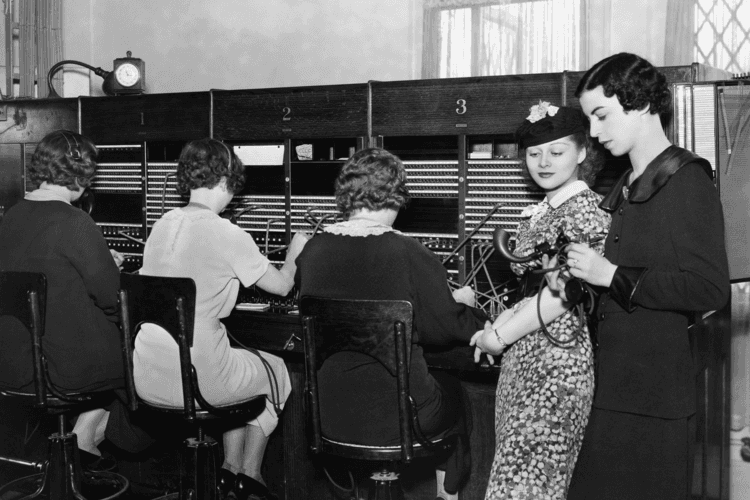
Into the early 1900s, phone exchanges were made using a switchboard. In 1891, Almon B. Strowger invented a way to communicate using a telephone without an operator because he was losing business to a competitor. The competitor’s wife, who worked at a local telephone exchange, continually redirected calls for Strowger to her husband.
The machine would move based on pulses from two-way phone signals, allowing the operator to make contact with another person. Strowger actually made the first automatic telephone exchange using just a round collar box and straight pins.
However, while patented, this technology wasn’t utilized extensively until the 1920s.
Picturephone
With a desire to add video to phone calls, AT&T debuted its Picturephone in 1964 at the New York World’s Fair. However, because the device was so bulky and expensive, the gadget initially failed. Continuing their research, AT&T opened Picturephone rooms in New York, Chicago, and Washington that same year, drawing a bit of interest. However, only 71 calls were made in six months, which were lower numbers than anticipated.
AT&T was way ahead of the curve considering the popularity of FaceTime today. The Picturephone had a 5.25” x 5” screen, 30 interlaced frames per second, white picture at 250 lines resolution, and the sound worked through a touch-tone speakerphone. The Picturephone never made it off the ground, largely because the service only worked if both users had a Picturephone.
Cordless Phones
The first concept of the cordless phone was coined the Carterfone and utilized a two-way radio system connected to a telephone, allowing users to walk around as they spoke on the phone. While the Carterfone was on to something in the 1950s, the first commercially-sold cordless telephone was released by Sony in the 1980s. But just like all technology, the first edition had many issues, including poor range, problems with interference, and a short battery life.
Siemens Phone to Smartphones
Let’s get into what we all came here for: the smartphone. The 1990’s saw a rapid rise in cell phone use, although it’s nothing compared to today.
In 1990, the number of mobile users was merely 11 million; now it is nearly 3 billion. This really started with the Siemens Phone in 1985, which was a suitcase cellphone. Yes, this phone was literally a suitcase — which is hard to imagine with many of us now having iPhones that fit in our back pocket.
After the Siemens Phone came the brick-like Nokia and Samsung phones, until finally, in 1989, the first flip phone was released by Motorola. In 1992 the first text message, reading “Merry Christmas!,” was successfully sent. While 1994 saw the first Simon smartphone with a touchscreen, it wasn’t until 2007 when the now widely popular Apple iPhone dropped.
The first iPhone was tiny, sizing up at just 4.5” x 2.4”. While it had its issues — including a dodgy network — and a number of doubters, it was extremely important to the evolution of the smartphone. Just one year later, the iPhone 3G was released, which included multiple apps, and the first iPhone was discontinued.
In 2007, Apple sold just 1.9 million phones; in 2017 they sold nearly 217 million.
The Pros and Cons of Smartphones
It is hard to picture a world in which we can’t pull out our cellphones and send a quick text message explaining why we’re late for lunch or scroll through Twitter on our commute to work. There are numerous pros and cons to our ability to share our lives online and communicate effortlessly, and social media has become a central way for Millennials to spend their spare time.
Some pros include the simple ability to remain in touch with people who don’t live in the same state or country as us, work remotely successfully, and keep a sort of digital scrapbook of our lives. However, cons do include an inability to step away from work, becoming easily distracted, and the urge to compare one’s life to a social media influencer’s curated Instagram feed.
Despite these pros and cons, there is no doubt that smartphones will stick around. But where can smartphones go from here?
Perhaps they will begin to use alternative power sources, making it unnecessary to plug phones into outlets to charge. Or, maybe, we will eventually be able to build our own phone — similarly to how we can now choose specific parts for computers to customize them.
If it were up to me, I’d opt for a stretchable phone.
For more nostalgic tech, read about the GameBoy, Leapfrog, and Tamagotchi here.