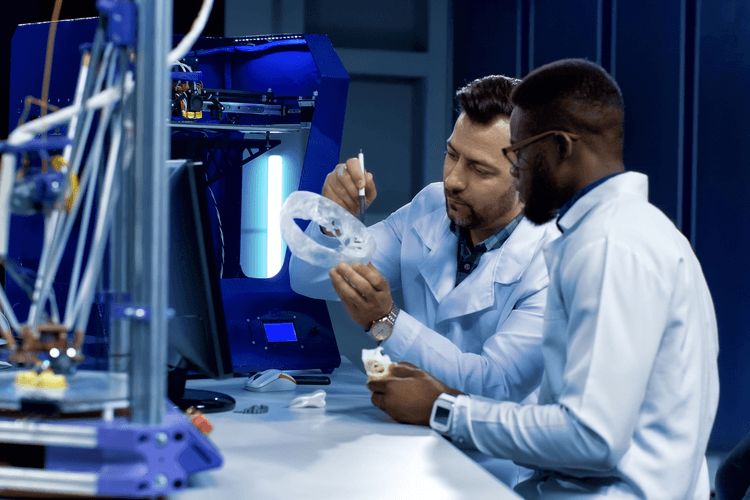
A new system of 3D printing could one day allow for a more practical way to produce parts made of numerous different materials.
Recently, University of Wisconsin chemists detailed research in which they aimed two light projectors at a single reservoir of basic chemicals, and used different light wavelengths to dictate how those chemicals should be arranged to form — and print — polymers.
As a result, the team built a part comprised of both rigid epoxide and softer acrylate from the same pool of starting material.
Currently, printing components made of multiple materials requires the use of several different reservoirs.
The study used chemicals capable of both coexisting in a single vat and curing at similar paces, but scientists eventually hope to deploy new chemicals and wavelengths in order to be able to print more complicated parts.
Researchers said the technology could be particularly helpful for the development of personalized medical devices.
Johanna Schwartz, a UW chemistry graduate student, said in the release that the “interface of chemistry and engineering … will propel the field to new heights.”
The study was published in the journal Nature Communications.











![NASA Releases Spacecraft Technology Report [Part 2]](https://machinerys.net/upload/cache/202506/nasa-releases-spacecraft-technology-report-part-2.webp)