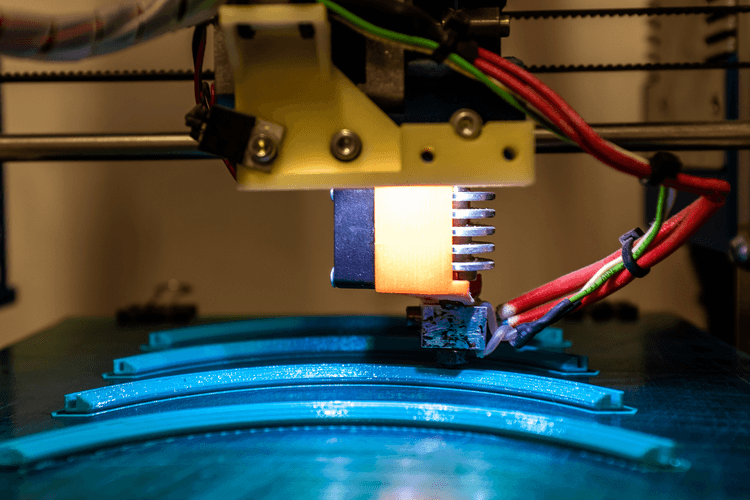
A 3D farm is an operation that focuses on 3D print manufacturing on a large scale. It is where multiple 3D printers run simultaneously, thus increasing the production rates of the printed items.
Because 3D printing bypasses time-consuming and costly steps, 3D farms are becoming more common. So how do these farms work?
Online Platform for Orders
Most 3D farms have an online platform where users can upload 3D files and receive instant pricing for their desired products. Users will have to choose specifications such as additive manufacturing technology, infill percentage, and material. Then, the 3D farms fulfill the order through various printers depending on requirements.
Worth Noting: Most 3D farms have various facilities running different materials, the most common being rigid or flexible plastic, but some will also have metallic offerings such as titanium, steel, aluminum, and Inconel.
3D Print Farm Process
Once an order is received it will then be sent to application engineers to assign processing parameters according to customer specifications and the process selected. The engineer will also add the part to a build plate along with other customer’s parts to use as much of the available build volume as possible, and in the case of SLS they can even nest parts vertically.
Once the part is complete it will go through various post-processing such as removing support structures in the case of FDM printing or chemical surface smoothing for SLS printed parts. SLS parts can also be dyed to achieve various colors. If additional colors are desired, PolyJet printing can also be used for full-color products. Other post-processing can include adding metal screw inserts to improve the functionality of the product.
Once all post-processing is complete the final product can be shipped to the customer. From start to finish, parts can be shipped out in as little as 2-3 business days.
Why Do Farms Use Multiple Printers?
High-output 3D printing businesses have farms of 3D printers because batches of parts can be split over various machines decreasing the total time it takes to complete a project. For example, consider a customer ordering four parts that each take eight hours to produce. On an individual machine that build time may stack to 32 hours total. However, if four machines are running one part each, the project is complete in eight hours. This efficiency, combined with redundant printers in case one requires maintenance, allows 3D print farm businesses to higher throughput compared to hobbyist or in-office printers.
3D Printer Types
FDM Printing
Fused deposition modeling (FDM) printers offer a low-cost, proven process for creating objects through additive manufacturing. This technology allows for making larger objects in plastic materials. Most 3D farms use FDM printers to create parts around 14 to 16 inches, but they can produce parts less than .5 inches in size up to 40 inches.
A common material used by these printers is Polylactic Acid (PLA). PLA is a commonly favored material for desktop 3D printing due to its stability and resistance to warping and coming loose from the print bed. Other plastics such as ABS, nylon, Ultum, polycarbonate, and others can also be used in FDM printers. A disadvantage of filament-based 3D printing is small detail resolution which may be incomplete, coarse, or fragile due to layer and filamet size.
SLS Printing
Some 3D farms also use Selective Laser Sintering (SLS), an additive manufacturing technique that uses lasers to sinter powdered materials to create parts. SLS printing offers higher resolution, faster print times, better mechanical properties, and can produce more complex geometries than FDM printing.
The downside to this is that the end products may cost more due to higher costs of materials and machines. When compared to FDM, print size is also a limitation of this type of machine.
PolyJet Printing
Often, 3D farms offer color dyeing as a printing step to provide parts with the specific color requested from the order. However, some 3D farms also offer PolyJet printing, a powerful resin-based platform that makes color prints like an inkjet printer. There are many advantages to this new technology for additive manufacturing including:
- Smooth surface finish
- Multi-material and multi-color capability
- Fast print times
- High dimension accuracy and resolution
- Good for complex geometries
- Low material waste
Since this is a new technology, disadvantages include being one of the more expensive additive manufacturing methods and the material selection is limited to photo resins which are typically more fragile than thermoplastics.
Metal 3D Printing (DMLS)
Direct Metal Laser Sintering (DMLS) can also be called Selective Laser Melting (SLM). This technology uses a laser to fuse fine metallic powders together to produce the final product. This technology can be used in 3D print farms to manufacture parts for jet engines.
The Future Is 3D
Overall, it comes down to the cost of the part, lead time, end use of product, dimensional accuracy, and surface finish needed to determine the best additive manufacturing process. 3D print farms are transforming manufacturing for various industries, and consumers can only anticipate greater improvements in the coming years as new technologies emerge in this exciting field of manufacturing.
Related 3D Printing Resources
- Xometry offers access to 3D suppliers. Upload a 3D model to get instant pricing, lead time, and DFM feedback on the Xometry Instant Quoting EngineSM
- Take the free interactive e-course Principles of 3D Printing Design for Industrial Engineers
- Check out the Xometry article Best Practices for a High-Output 3D Printing Business
- Watch the YouTube channel Nathan Builds Robots tour one of Xometry’s facilities