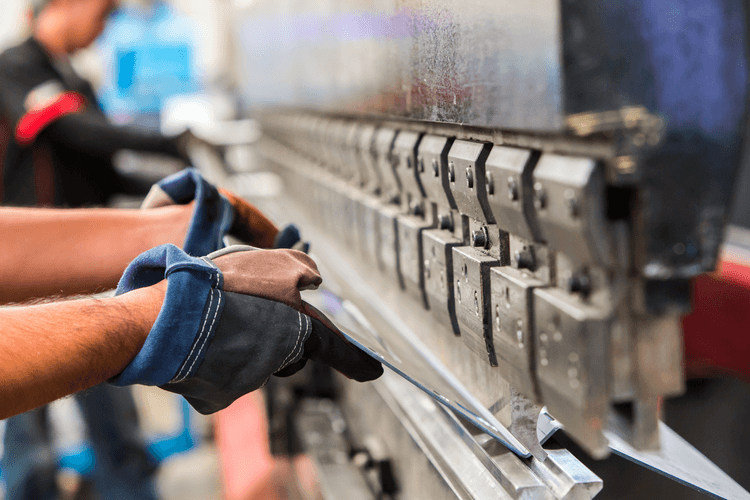
As part of a project funded by the U.S. Army Research Office, materials science and engineering researchers at the University of Wisconsin-Madison recently demonstrated new approaches to metal bending that could allow for strengthening materials without the risk of fracture.
Current processes, such as cold working or annealing, which are used to manipulate the strength of a metal, exert their effects through small structural irregularities called dislocations. Dislocations are tiny irregularities, or slight mismatches, in the lattice of a metal.
Metals bend because dislocations are able to move, allowing material to deform without ripping apart every single bond inside its crystal lattice at once. Strengthening techniques typically restrict the motion of dislocations. It makes the metal stronger and less flexible.
The recent discovery made by researchers was that a material called samarium cobalt, classified as an intermetallic, bent even though its dislocations were locked in place. Typically, such a metal would be seen as brittle and break when bent.
Bending samarium cobalt caused narrow bands to form inside the crystal lattice, where molecules assumed a freeform configuration instead of the grid-like structure of the rest of the metal. These bands are what allows the metal to bend without breaking or losing its strength.
Next steps will entail searching for other materials that bend in a similar manner. Eventually, this could lead to tuning a material’s properties to optimize both its strength and flexibility for military, automotive, or construction applications.