
Every year, economists try to predict the year’s economic outlook to determine the future gross domestic product (GDP) growth rate. This has been particularly challenging to nail down the last few years due to supply chain disruptions, consumer confidence, and labor shortages. Consequently, there is a large gap when it comes to accurately predicting the future of industrial manufacturing forecasting.
“We didn’t see anyone in the marketplace accurately predicting industrial production in manufacturing,” said Keith Prather, the managing director and partner at Armada Corporate Intelligence. “So, we went in, and we used an analytical modeling approach and discovered 18 to 20 different economic metrics that we can throw into an analytics model that allows us to predict industrial production manufacturing.”
Currently, his forecasting model is 98.8% accurate three months out and 93.3% accurate six months out.
For more than 15 years, Prather has delivered manufacturing insight to corporate leadership. But over the last two years, he and his business partner have dedicated their time to developing a reliable and accurate forecasting model for industrial manufacturing, offering insight into sectors from aerospace to computers and electronics.
This is critical because accurate forecasting can help anticipate potential disruptions, shortages, or spikes in demand. Through manufacturing forecasting, companies can better meet production demand without going into a surplus. It plays a significant role in the push and pull components of supply chain management.
In the latest episode of the Thomas Industry Podcast, Thomas’ Vice President of Platform Growth and Engagement, Cathy Ma, chatted with Prather about the economic metrics behind his forecasting model and what he’s predicting for the manufacturing sector in 2023.

Managing Director & Partner at
Armada Corporate Intelligence
Explaining Industrial Manufacturing Forecasting
“Typically, when [manufacturers] look at modeling, they look at a dataset like industrial production,” Prather said. “They look at the historical pattern of that, and then they try to forecast forward how industrial production will move. But we take a different approach.”
As industry continues to overcome the ripple effects of supply chain disruptions, Prather explained how his forecasting model uses high-level analytics and statistics to predict industrial production in manufacturing.
“We say there are things that move businesses: raw material inputs, supply chain activity, and consumer demand. We split it into the supply and demand sides of it,” he said. “We discovered that if you can take those inputs and pressures and items that push on a business, you can better forecast and understand where that business will go in the future.”
Prather explained that by taking the items that both create and depress demand and “throwing them into a big blender,” he is able to predict 2023’s outlook with a high degree of accuracy. “We took that economic understanding, 18 to 20 different economic metrics, and two years [to build it],” he said.
While there are other forecasting models out there, very few are focused on industrial manufacturing production. Prather’s model can forecast 18 months ahead and covers automotive, aerospace, machinery, computers and electronics, and electrical and appliances.
2023 Manufacturing Outlook
When we chatted with Prather, he explained that in February, manufacturers were a lot more optimistic about the future of industrial production than expected. He added that supply chain backlogs are finally clearing up, and companies can now order the materials they count on. Consumers are also “spending money like it’s water,” he said.
“If you look at consumer spending, it’s still extremely high — historically much, much higher than it was prior to the pandemic,” he said. “That consumption is going to continue to keep the demand for manufactured goods [up], and so that’s why I’m a little more optimistic about the future.”
Aerospace and Automotive
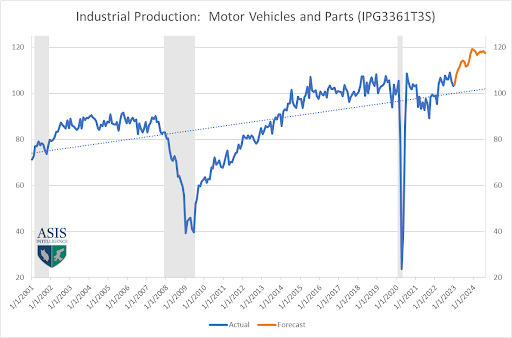
For the aerospace and automotive sectors, Prather’s forecasting model picked up on a bit of sluggishness at the beginning of 2023, attributed to supply chain strains. However, he said, in the back half of 2023 and into 2024, supply chains are anticipated to enter their normal cycles, creating rapid growth for the sectors.
“The demand side of the aerospace curve is still very strong, [whether] you look at the civilian side or the commercial side of aircraft manufacturing,” Prather said. “They have a really bright horizon over the next decade. You see demand being very strong, with backorders stretching out for a significant period of time. Any sluggishness in the models right now is related to inventory and supply chain issues.”
Prather added that the automotive sector is facing a similar trend. As microchip shortages turn into other component shortages, those supply chains are trying to get back in cycle and get all the parts they need to produce vehicles to meet demand. Prather’s model is showing a bit of “sluggishness” as the sector’s supply chain tries to dig out of its challenges to hit a “growth rate that matches its demand rate.” But the future is bright.
“The models are showing super strong growth rates above the 10-12 year trend lines, especially in automotive. Aerospace isn’t far behind,” Prather said.
Listen to the Full Thomas Industry Podcast Episode

In the full episode of the Thomas Industry Podcast, Prather dives deeper into what his forecasting model is showing, including more trends for aerospace and automotive, what’s in store for the computer and electronics industry this year, and 2023’s overall manufacturing outlook.
You can listen to the full episode on the streaming platforms below.
- SoundCloud
- Spotify
- Apple Podcasts
- Stitcher
For more episodes of the Thomas Industry Podcast, visit Thomas Insights.









![Where Does New York City Get Its Electricity? [A Byte Out of the Big Apple]](https://machinerys.net/upload/cache/202507/where-does-new-york-city-get-its-electricity-a-byte-out-of-the-big-apple.webp)