“Prediction is a dangerous business,” hedges Shawn Davison.
Tony Uphoff has just asked him where he thinks the Internet of Things (IoT), Industrial Internet of Things (IIoT), and Industry 4.0 are headed, during their conversation on the Thomas Industry Update Podcast. It’s a question we’ve all been examining, and we’re eager for Davison’s expert opinion.
For more than 30 years, Davison has been building architecting software products and services. The software architect is now CEO ofDevIQ, which builds software to help its clients flourish. The DevIQ websiteexplains the business model: “We use technology to redefine the way people work and enable them to achieve things previously not possible.”
With that range of personal experience in the industry and his company’s mission to help other businesses thrive, it’s no wonder Davison considers the question carefully before answering. As an industry leader, he’s been analyzing the trends, though, and he offers his perspective based on what he sees at DevIQ.
“Automation Will Be a Requirement”
“I think that AI is going to continue to mature in a significant way,” predicts Davison.
“One of the things that I think is very important to understand is that software and technology are becoming more complex, not simpler,” says Davison. “There are more devices. There are more components, and software is becoming more distributed. It’s much, much more complex. I don’t think that that’s going to stop.”
It may sound daunting, but he’s not deterred. “What mitigates that complexity and the risk of complexity is automation,” he says.
“AI is somewhat of a form of automation. Automation enables us to keep up with that complexity and the technology. So [in] software development… we have to automate testing in a big way,” Davison explains. "Because if we don’t automate testing, the risk of regression is really high. That becomes pervasive across, essentially, the entire ecosystem in building software and technology. You’ve got to create automation techniques around that.”
“Automation will be a requirement, not an optional item in the future because you simply won’t be able to deal with the technology or software without it,” he argues.
Where Will We See Automation?
Automation is already spreading across industries and even in personal use. It’s being used not just to save money and to increase efficiency but to better lives and the environment. There are numerous applications, but here are a few that Davison focused on when speaking on the Thomas Industry Update Podcast.
Factories
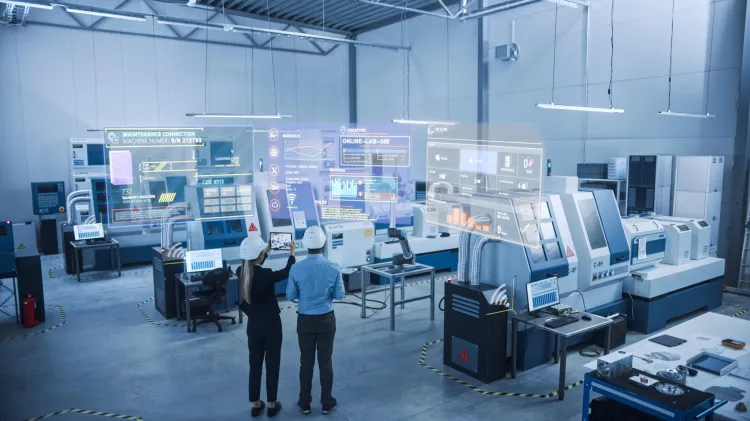
Quite notably it’s being used on factory floors, and Davison posits that lighting automation is the path toward the IIoT. DevIQ has an IoT management system that went live during last year’s Light Fair.
He explains that although they were at first interested in lighting systems, they did visualization of IoT. “It basically enables control and visualization of IoT ecosystems and device networks,” he explains, "and allows you to see tens of thousands of devices and visualize those on one single glass.”
Healthcare
Similar principles are being applied to advancing the medical field through automation. “We’re actually melting IoT and healthcare together in that we’re working with healthcare testing labs to automate their testing flows using IoT and software,” Davison says, exploring some of DevIQ’s projects. He explains: “Wearables are part of that in terms of collecting data.”
Wearables are products like continuous glucose monitoring devices, Fitbits, and hearing devices. According to IDTechEx’s report, since 2014, the wearables sector has doubled and right now is valued at more than $50 billion. Last year, Google acquired Fitbit for $2.1 billion. Another wearable form, smart skin patches, which can be used for cardiovascular monitoring and diabetes managing, raked in $7.5 billion in 2018 and is expected to grow to $20 billion within the next decade.
Homes
“Another example that we’ve contributed to is smart panels in the home, whether it’s a panel that controls your security system that’s connected to the cloud or an iPad or mobile device,” says Davison.
“All of that is IoT at some level. The question is, is it connected?,” he posits. "Is it doing things on its own that do not require human intervention? And is it passing data and providing significant value in that respect?”
DevIQ worked with Nortek Security & Control, the largest home automation manufacturer for new builds of homes, to bring automation home. In addition to wireless smart panels, they worked on home security.
According to ADT’s report in 2019, the security system’s earnings went up 12% to $5.1 billion, and they saw an increase in home automation with at least an 80% interactive take rate. Vivant, meanwhile, announced this year: “We were excited to complete our merger with Mosaic Acquisition Corp. in mid-January, initiating our next chapter as a leading public smart home company.”
“We’re at a Tipping Point”
Global spending in the field of the Industrial Internet of Things (IIoT) is expected to increase 40% over the next four years. Darren Sadana, Choice IOT’s CEO, suggests this spending will be a result of autonomous IoT platforms replacing software-driven manufacturing machines.
Davison has seen the evolution firsthand. He explains how he began his career: “For me, it actually started in the late ’70s when I had the opportunity to play with an Apple II computer. Steve Wozniak, who was one of the cofounders of Apple, was my hero as a teenager. I quickly became very focused on building software. To fast forward, in short, I built six software and technology companies over the years, and three have gone on to be acquired by large public companies today.”
Now, with the IoT and Industry 4.0, he says, “There’s a significant convergence of software and the physical world. That’s where it gets really exciting in that that blend of what was simply on a computer before is now all around us in the industrial environment.”
“I think we’re at a tipping point,” says Davison, speaking of the state of Industry 4.0 in 2020.
Want More Insight into the Future of IOT and AI?
- Listen to Shawn Davison on the Thomas Industry Update Podcast on Apple Podcasts
- Read why Shawn Davison says AI will "Eat Software and Data” as leaders navigate the future of industrial AI
- Discover Shawn Davison’s take on lighting automation’s role in the industrial IoT (IIoT)
- Find out why Thomas CEO Tony Uphoff believes businesses should be investing in new technology amid COVID-19
- Find all the Thomas Industry Update Podcasts here.