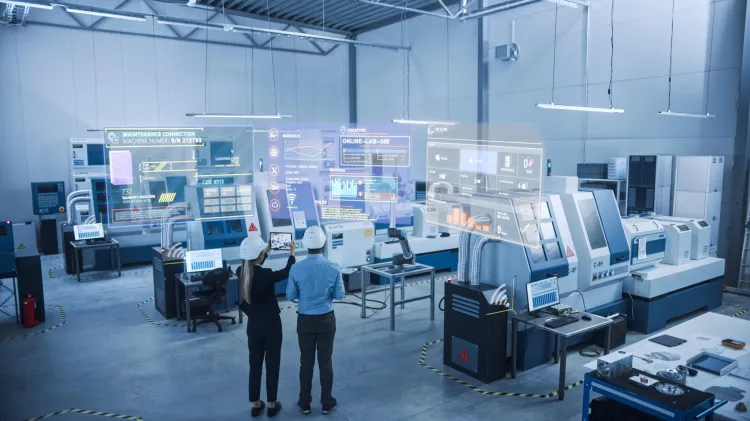

Years ago, if a frustrated engineer started yelling at a piece of malfunctioning machinery on the factory floor, they wouldn’t expect it to answer back. But that’s about to change in a big way with the arrival of voice assistants in the manufacturing sector.
Owners of smart speakers and voice assistants in the home will know that the more IoT devices you have online, the more value you will get out of your investment. Alexa, for example, can function perfectly well as a stand-alone device (performing web searches, finding your favorite tunes on Spotify, or letting you know the weather forecast), but when that same assistant is able to interact with your IoT-enabled locks, light switches, your heater, air conditioner, and kitchen appliances, that’s when it moves from an interesting toy to an indispensable home hub.
Similarly, voice assistants can act as the one-stop hub for your IIoT-enabled manufacturing plant. It makes sense to have a way to seamlessly link all of your devices, and even more sense when the technology used is already familiar to many of your workers. Supply Chain Dive reports that about 25% of warehouses were using voice-directed picking as of 2018, but this is just one of the cases of voice assistants in manufacturing.
Two obvious but important benefits are the hands-free (and eyes-free) nature of a voice assistant. Users will not have to put down tools to pick up an iPad and can continue working on their task while initiating a conversation with the device. Notably, not having to look at a screen greatly improves accessibility for vision-impaired employees.
A voice assistant in a manufacturing environment can also:
- Provide answers to status queries
- Offer possible solutions to problems based on past data
- Create work orders, log asset information and retrieve data
- Use Natural Language Processing technology for better speech recognition and no need to “train” a voice assistant to understand individual users
- Integrate with in-house asset management or condition monitoring programs
- Be WMS agnostic and device agnostic
- Perform common business tasks such as sending messages, accessing calendars, scheduling meetings, and utilizing popular programs including Salesforce