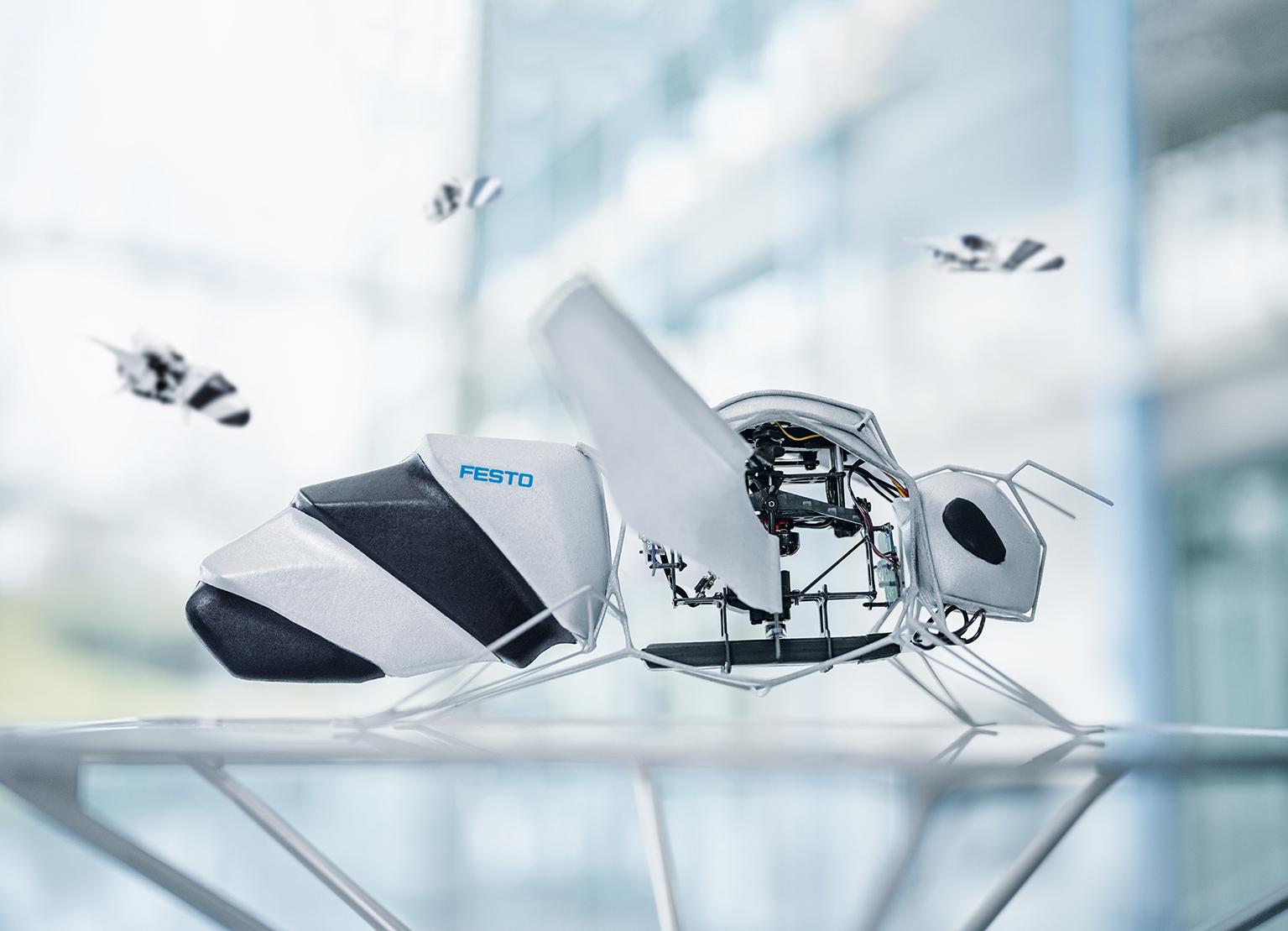
The Bionic Learning Network, a collaboration of small companies, research departments, and universities, debuted its BionicBee at Hannover Messe 2024. Described as the network’s smallest flying object, the 8.6-inch bee weighs around .07 pounds and features a wingspan of 9.4 inches.
How Do BionicBees Find Each Other?
According to the Bionic Learning Network, an indoor locating system with ultra-wideband technology allows the BionicBee to fly autonomously in large numbers. The design’s eight ultra-wideband anchors send signals to the “bees,” which enable them to measure the distances between each other and determine their position.
BionicBees Avoid Collisions
The bees navigate in a swarm by following a central computer’s predefined paths. To prevent collisions, they maintain precise temporal and spatial accuracy while also accounting for potential mutual interactions caused by air turbulence.
The bees also feature an automatic calibration function. Following a test flight, each bee identifies its individually optimized controller parameters. The algorithm then calculates hardware distinctions among individual bees, enabling external control of the swarm as if the bees were uniform.
Generative Design Was Key in Development
The handmade BionicBee was created with generative design, during which a software application used established design principles to determine the optimal structure, which helps minimize material usage and maintain stability.
Image Source: Festo