Widely used across a range of industries and applications, both plasma and laser cutting allow for great versatility and accuracy.
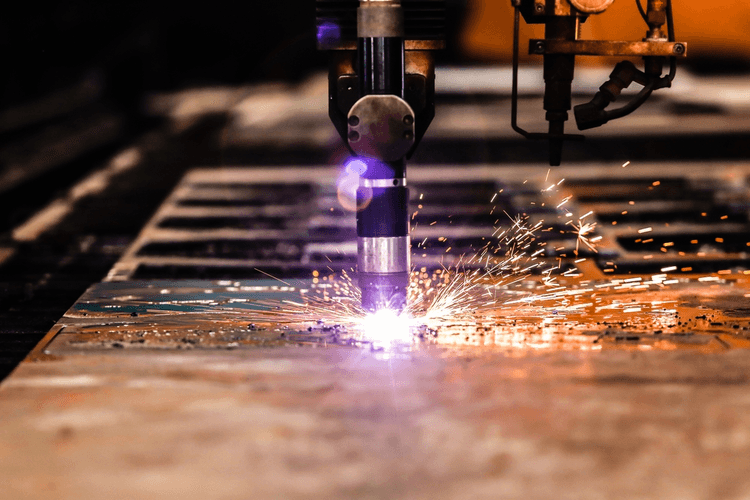
Laser cutting, as its name implies, makes use of a high-powered laser to cut materials. This is typically done through the use of optics combined with computer numerical control (CNC) to direct the laser beam onto the material, which is either burned, melted, vaporized away, or blown away by a jet of gas. This leaves an edge with a high-quality surface finish.
Plasma cutting, on the other hand, makes use of an accelerated jet of hot plasma to cut through electrically conductive materials, such as aluminum, brass, copper, steel, and stainless steel. This process allows for high speeds, low costs, and precise cuts in wide-ranging applications.
Laser Cutting
Laser cutting offers a range of advantages over mechanical cutting techniques. First off, the laser process allows for easier workholding as well as reduced workpiece contamination, as there is no cutting edge that can become contaminated and consequently contaminate the material.
Laser cutting can be used for materials that would be too thick or hard for mechanical techniques, and can be employed for parts with unique or complex non-circular geometries. The process is also very versatile and cost-efficient, and can be used to cut a wide variety of materials.
Laser cutting is used across many different industries and applications, including:
- Aerospace
- Agricultural
- Construction
- Contract manufacturing
- Military and defense
- Mining
- Original equipment manufacturing
Plasma Cutting
Plasma cutting is ideal for cutting both thin and thick materials. And since plasma cutters produce a high-heat, localized “cone” for cutting, the process is especially well-suited for cutting sheet metal in curved or angled shapes.
Plasma cutting is also unique in that brings about minimal warping — allowing for clean, even cuts without distortion — and does not create a wide heat-affected zone (HAZ) that can burn or melt cardboard, metal, or wood. Commonly worked materials include aluminum, carbon steel, and stainless steel.
Plasma cutting is used across many diverse industries and applications, including:
- Aerospace
- Agricultural
- Boom components
- Frame rails
- Lifting equipment
- Military and defense
- Mining
- Pipe fittings
- Truck cranes
- Wear parts
Choosing the Right Cutting Method
While both plasma cutting and laser cutting offer a range of unique benefits, the ideal technique for a certain application will depend on the specifics of the job at hand.
For applications requiring tight part tolerances, laser cutting is usually ideal, as it utilizes a highly focused beam of light to complete cuts. Laser cutting is also well-suited to parts requiring precise cuts or small hole diameters in relation to the thickness of the material. Laser cutting is typically used for thinner metals, while plasma cutters can handle thick sheet and plate metal. Most modern plasma cutters can handle metals up to 80 mm thick.
For parts requiring simple, straightforward shapes without many cutouts or intricate notching, plasma cutting is a better option. Plasma cutting can also cut metal with reflective surfaces, which cannot be handled by lasers. Plus, plasma machines are able to be employed for many different purposes, such as scribing, trimming, welding, and engraving. Plasma cutting equipment is generally more cost-efficient than laser machines — especially when dealing with high-end models — and ensures high-quality part replication.
Although plasma cutters have a smaller kerf than laser cutters – which means less material is lost during the profiling process – laser cutters allow for slightly tighter tolerances. Both plasma and laser cutters can be easily integrated with CAD/CAM tools.
Finding a Laser or Plasma Cutting Partner
Laser and plasma cutting are ideal solutions for many different industrial applications, with each technique offering its own unique features and benefits.
To ensure optimal part quality and efficiency of operations, be sure to partner with a cutting service provider who will be able to guide you through each step of the process and work closely with your team to select the ideal solution for your unique application.
Resources:
- https://www.gemathis.com/laser-cutting-vs-plasma-cutting/
- https://en.wikipedia.org/wiki/Laser_cutting
- https://www.thefabricator.com/article/plasmacutting/cut-it-out-how-fabricators-use-plasma-cutters-every-day
- https://www.parkersteel.co.uk/Blog/Laser-Cutting-Vs-Plasma-Cutting
Image Credit:Ake Apichai Chumsri/Shutterstock.com