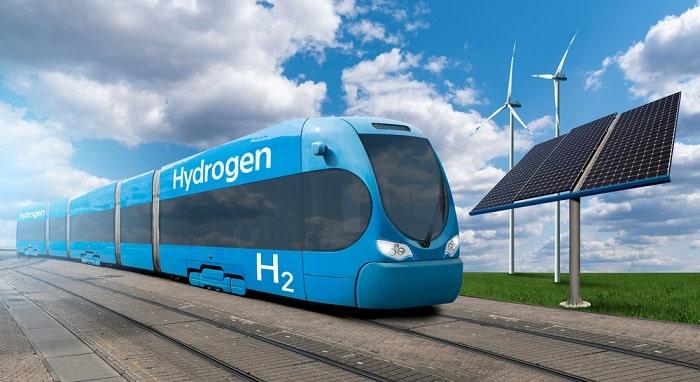
Following the rise ofhydrogen-powered trucks,race cars, andpassenger cars, hydrogen trains are set to revolutionize rail transportation and the rail industry in general. These trains are powered by hydrogen fuel cells instead of traditional diesel engines or electric overhead lines. This makes them extremely energy efficient with zero emissions produced. Although their efficacy in decarbonizing transportation is a debatedtopic, there’s no doubt that the introduction of hydrogen trains has the potential to play a large role in sustainable rail transport, reduce the rail industry’s environmental impact, and enhance energy efficiency.
In this article, we’ll delve into the potential benefits of hydrogen trains and their history, and take a peek at what the future holds for this new mode of transportation.
Hydrogen Trains—Benefits
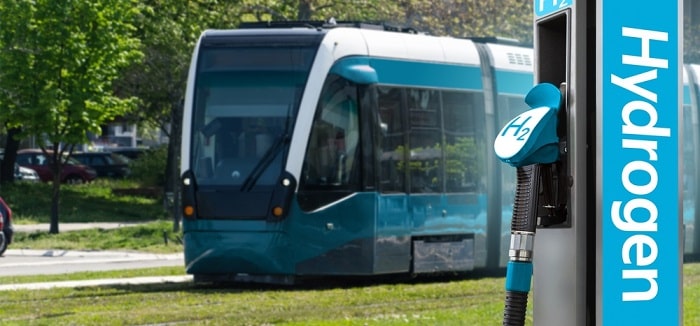
Image Credit: Shutterstock/Scharfsinn
Hydrogen-powered trains use hydrogen gas stored in tanks on board the train, which is then combined with oxygen from the air in a fuel cell to produce electricity. This electrical energy powers the electric motors that drive the train’s wheels and propel the train forward. One reason that hydrogen-powered trains are set to be all the rage in the rail industry in the near future is that they have zero emissions at the point of use, making them environmentally friendly and reducing pollution in urban areas.
They’re also much quieter than diesel trains during operation, resulting in reduced noise pollution along railway lines. These hydrogen trains are also versatile; they can operate on non-electrified railway lines, offering a flexible solution for regions without extensive electrification infrastructure. In addition, they offer superior energy efficiency compared to traditional diesel-engine trains as the fuel cells are excellent at converting hydrogen into electricity.
Hydrogen-Powered Train History

Image Credit: Shutterstock/Anne Richard
Although hydrogen trains are all over recent news feeds, the concept is not new. The first hydrogen-powered train, a 3.6-tonne mining locomotive, wasintroducedin Quebec, Canada, in 2002. In 2006, the East Japan Railway Company (EJRC) developed thefirst ever hydrail railcar, and Japan’s Railway Technical Research Institutecommenced testson a 70-ton, fuel cell intercity train. A mini-hydrail was demonstrated for educational purposesin Taiwanin 2007. A year later,the EJRC testedits hybrid fuel cell NE Train in Nagano.
Freight train company BNSF Railway, with support from the US Army Corps of Engineers and Vehicle Projects Inc., developed aswitcher hydrogen fuel cell locomotivein 2009 which took its first trip in 2010. In 2012, Denmark’s Hydrogen Train Projectstarted buildingEurope’sfirst hydrogen-powered trainby using hydrogen in an internal combustion engine. Later that year, the University of Birminghamdeveloped a scaled powertrainfor testing, and in 2018, it unveiledthe UK’s firstfully operational hydrogen train.
Southwest Jiaotong University in China demonstrated itsfirst hydrail prototypein 2010, and in 2012, South Africabegan testingout five PEMFC Trident new-era locomotives at itsmining operations. Two German states entered into anagreement with Alstom SAfor the testing of two fuel cell trains in 2014. In 2015, Aruba’s Downtown Oranjestad hydrogen-cell batterystreetcarcommenced operation,Dubai’s Downtown Trolley Projectwas set to start making trips, and a 380-passenger tram in Qingdao, China,was unveiledby CSR Sifang Co Ltd.
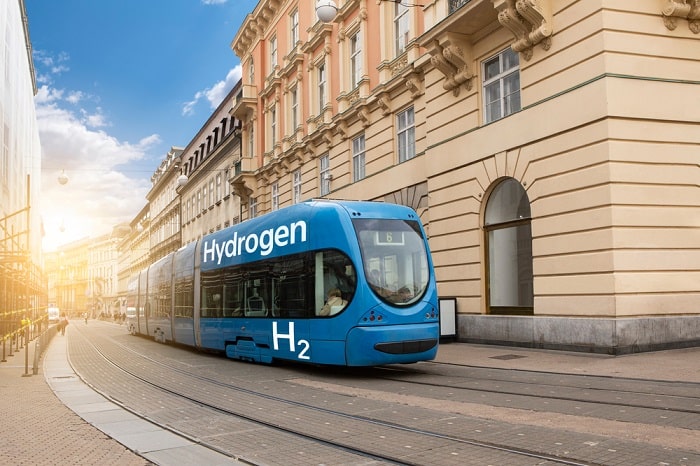
Image Credit: Shutterstock/Scharfsinn
In 2016, French rail manufacturer Alstom introduced theiLint train, and, a year later, the Lower Saxony local transportation authority ordered 14 of them. The world’s first commercial fuel cellhybrid tramwas manufactured in the same year by CRRC TRC in China. A year later,Alstom proposedtesting out a hydrogen train on England’s Liverpool to Chester line, with the company opening a facility in the area. Malaysia jumped aboard the hydrogen power train trendin 2018, proposing that its Kuching Light Rail Transit system be powered using only hydrogen fuel cells, but the project wasput on holddue to lack of funding.
In 2019, the EJRCinvested in the developmentof a train set using Toyota’s hydrogen fuel-cell technology—the company has already been using this tech in itsMiraihydrogen-powered vehicles. In 2021, the French Railway Company (FRC) said that its fully diesel-powered train line, the Caen-Alençon-Le Mans-Tours in Northern France, would make afive-year transitionto hydrogen trains by adding several Hydrail to its fleet. The FRC ordered 14 of these from Alstom for €200 million.
Hydrogen-Powered Trains in America
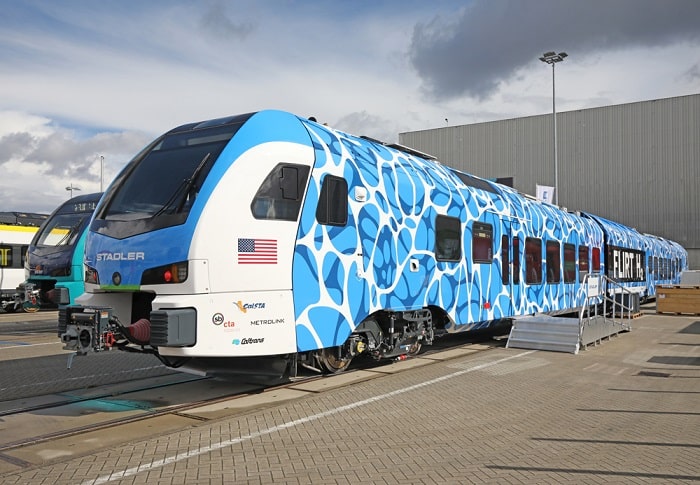
Image Credit: trains.com/Keith Fender
California is one of the states avidly looking into hydrogen technology and actively working to bring the first hydrogen train to America later this year in the hopes of bringing its railroad emissions to zero and greatly decreasing the reliance on fossil fuels. Swiss train manufacturer Stadler Rail AG was commissioned to make the hydrogen fuel cell train in the U.S. in 2019, and in 2022, the California Department of Transportation (Caltrans) and the California State Transport Agency ordered another 29 for use on Amtrak California services.
Caltrans and Stadler entered into an $80 million contract in October 2023 for Stadler to provide four sets of hydrogen-powered passenger trains, and included options for Caltrans to purchase more in the future. In February of 2024, Caltrans and Stadler entered into another agreement, this time for$127 million, to add six hydrogen-powered passenger trains to Stadler’s fleet, bringing the total number of California’s hydrogen trains to 10. The funding will come out of the$10 billion zero-emission vehicle packagethat the state’s governor, Gavin Newsom, implemented in 2022 towards this eponymous goal.
By 2027, the first of these hydrogen-powered vehicles should be operational between Merced and Sacramento. As of the latest news, there are 19 option trains left on the initial contract. In April 2024, American freight railroad company, CSX Transportation, incollaborationwith Canadian Pacific Kansas City (CPKC), showcased CSX’sfirst hydrogen fuel-cell locomotive, the GP38H2 No. 2100. Built at the company’s West Virginia Huntington Locomotive Shop, CSX used a CPKC kit to convert a four-axle unit to construct the train, along with several repurposed components from its other locomotives.
Hydrogen Fuel Cell Trains—Projects and Companies
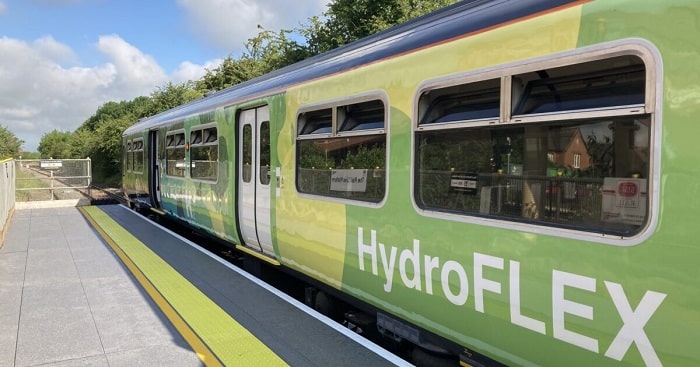
Image Credit: Porterbrook
There’s already a handful of major hydrogen-powered train companies with projects in the works. These companies are working hard to make hydrogen energy trains mainstream. In addition, various regions, including Germany and the Netherlands, have launched initiatives, like the Hydrogen Valley Initiative, to develop hydrogen train infrastructure, i.e., building hydrogen production facilities and refueling stations along railway lines.
Let’s take a look at some of the companies leading the way in the hydrogen train sector, and what they’ve been working on.
As briefly previously mentioned,Alstomis a French rail manufacturing company founded in 1929 that developed the Coradia iLint; the world’s first hydrogen fuel cell-powered passenger train. TheiLinthas already been deployed in commercial service in Lower Saxony, Germany since 2018, and is part of the country’s efforts to reduce rail transport carbon emissions. The iLint is based on the company’s Coradia Lint diesel multiple-unit train platform, with modifications to accommodate hydrogen fuel cells and tanks.
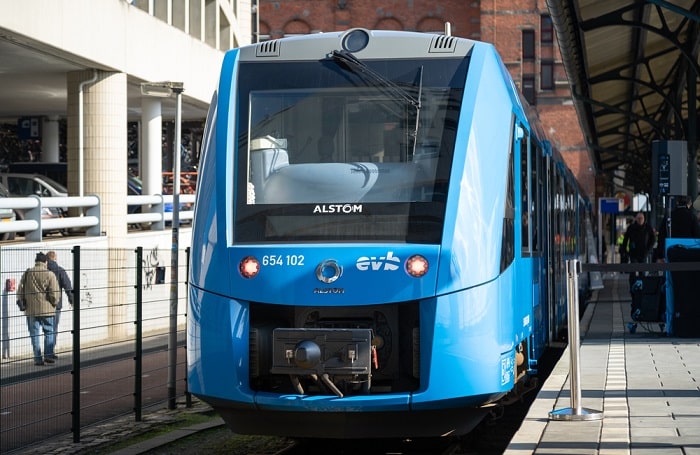
Image Credit: Shutterstock/Sander van der Werf
Similar to diesel-powered trains, the iLint has a range of around 600 miles on a single tank of hydrogen. The train emits only water vapor and condensation, making it an environmentally friendly alternative to diesel trains. The hydrogen used to power the iLint trains is produced via steam methane reforming (SMR), the most common method for producing hydrogen on an industrial scale.
CRRC, China’s state railway company, created the most powerful hydrogen-powered locomotive in the world—the Ningdong—in2023. The train can travel at 160 km/h with full load, and its engine can run for up to 190 hours. Refilling its 270 kg liquefied hydrogen capacity takes just two hours. Successfultrialswere completed in March 2024.
Porterbrookis a British rolling stock company (ROSCO) founded in 1994 as part of the privatization of British Rail. Along with Angel Trains and Eversholt Rail Group, it is one of the three original ROSCOs created during this period. In 2018, the company collaborated with theUniversity of Birminghamand funded byInnovate UKto make theHydroFLEX; the UK’s first passenger train converted to run on hydrogen fuel cells. It has undergone successful testing on mainline tracks.
A division of Siemens AG,Siemens Mobilityis a German sustainable mobility solutions company founded in 1989. It created theMireo Plus H, a hydrogen-powered version of itsMireoregional and commuter train. The Plus H is currently being tested, withsuccessful test runsunder its belt, and is expected to enter service in the near future.
Talgo(Tren Articulado Ligero Goicoechea Oriol) is a Spanish manufacturer established in 1942 specializing in high-speed trains, passenger coaches, and railway maintenance equipment. In January 2024, the company, along with nine other companies,announced plansto develop a high-speed hydrogen fuel cell-powered train system. The trains will be based onTalgo’s 250 trainwhich will be fitted with a dual-hybrid battery traction system using green hydrogen fuel cells and batteries.
Trains Powered by Hydrogen Fuel Cells—Summary
Hydrogen trains are an eco-friendly alternative to traditional diesel-powered trains. Using hydrogen fuel cells, these trains produce zero emissions and significantly reduce the rail industry’s environmental impact. As the world leans towards a more sustainable future and aims to fight climate change, the adoption of hydrogen trains seems like a great step.
As leading train manufacturers are working hard to make these trains and furthering their research, you may find yourself commuting on a hydrogen-powered passenger train sooner than you think!
Featured Image Credit: Shutterstock/Scharfsinn