Exoskeletons have a 130-year history. Today, powered exosuits are among the most intriguing emerging technologies in various industries, including construction and the military.
Below, we explore the various types of exoskeletons, their applications, advantages, challenges, and the future market.
What Is a Powered Exoskeleton?
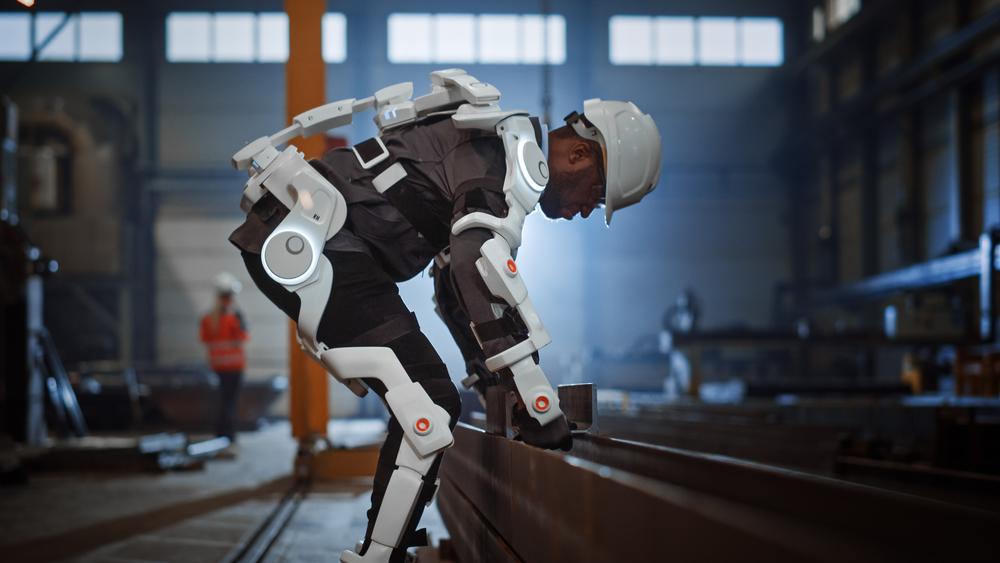
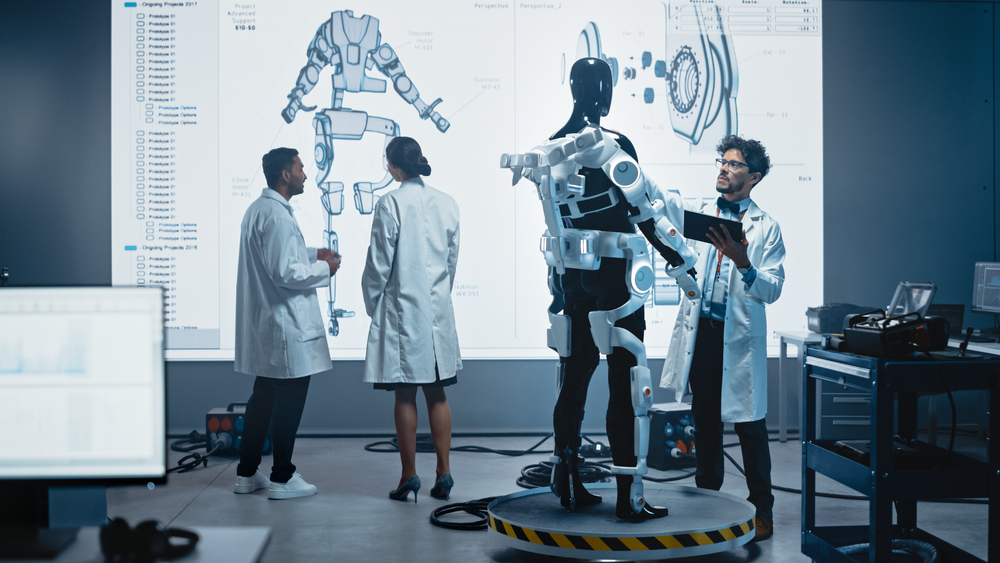
A powered exoskeleton is an early-version “Iron Man” suit, dispersing weight, correcting posture, and enhancing stability to improve endurance and boost productivity while reducing injuries.
However, many industrial exosuits are passive exoskeletons or unpowered. These options range between $4,000 to $6,000 and are as light as five to ten pounds.
Applications in Manufacturing and Supply Chain
Exoskeletons can transform workplace ergonomics, alleviate logistic challenges, and create safer, more efficient manufacturing centers. Successful use cases include:
Toyota
Toyota uses more than 500 exosuits, along with wearable sensors and VR tech, across numerous factories in North America.
Ford
Global Ford locations are offering EksoVest exoskeletons to reduce strain. For perspective, a worker may lift the equivalent of a watermelon above their head 4,600 times per day. Yet a shoulder-girdle-girdling vest can provide up to 15 pounds of lift assistance per arm.
GM
GM is trialing exoskeletons to great effect. The SuitX Modular Agile eXoskeleton (MAX) is a four-part suit supporting the shoulder, back, and legs. It can be combined with the Bioservo Ironhand, which increases hand strength by 15-20 pounds for extended periods or up to 50 pounds for short intervals.
Boeing
Boeing technicians wear exoskeleton vests to dispel the strain of constantly raising their arms to seal, paint, and sand commercial and defense aircraft, including Dreamliners, fighter jets, unmanned refueling systems, maritime patrol craft, and Air Force One.
Key Components and Technologies
Powered or active exoskeletons require some form of energy, such as a battery pack, to activate hydraulics, pneumatics, or motors. Metal, carbon fiber, and elastic fabrics are common building materials for mobility and comfort without sacrificing strength.
Exoskeletons also require sensors, actuators, mechanical structures, algorithms, and control strategies to interpret users’ intentions and initiate or support actions. They utilize three modules comprising sense, decision, and execution to gather data, analyze data, and actuate the exoskeleton according to the desired task.
Data capture logs metrics like speed, time, and distance to offer a simple human-machine interface for enabling control, sharing information, and customizing individual use patterns.
Types and Classifications of Exoskeletons
Exosuits can support the entire body, the torso, or the limbs, providing use-specific assistance for whichever body parts endure extreme or prolonged stress.
A full-body exoskeleton supports the lower and upper body of workers who must lift, hoist, hold, and carry heavy loads, such as construction workers. A lower-body exosuit encompasses the lower extremities and supports workers who consistently stoop, bend, squat, or assume other uncomfortable positions for extended periods.
An upper-body exoskeleton supports the upper extremities, bracing the shoulders and arms for workers who must drill, paint, inspect, or otherwise lift or keep their arms up for much of the workday, such as those in the automotive and aerospace industries.
Some exoskeletons may include a grasping component or be limited to the wrist to provide grip strength and dexterity for technicians like welders.
Gorodenkoff / Shutterstock.com
Top Manufacturers of Exoskeleton Suits
Leading exoskeleton manufacturers innovate to serve those in industrial sectors, the military, and therapeutic settings. The following companies are leading the charge.
1. Lockheed Martin
In 2018, Lockheed Martin received $6.9 million from the U.S. Army to develop the ONYX Exoskeleton, named after amulets worn by Roman soldiers.
2. Ekso Bionics
Headquartered in San Rafael, California, and founded in 2005, Ekso Bionics designed multiple exosuits to decrease upper and lower extremity pain.
3. Sarcos Technology and Robotics Corporation
Sarcos was founded in 1983 and now specializes in robotics and AI advancements. The Salt Lake City company has an underwater robotic arm system that is commercially available and is currently working on the Guardian family of robotic exoskeletons.
4. Cyberdyne
Japanese cybernetics firm Cyberdyne, founded in 2004, is developing a Hybrid Assistive Limb, or HAL, which detects bio-electrical signals through the skin to assist its users’ movements.
5. German Bionic
Based in Augsburg and founded in 2016, German Bionic creates wearable tools that capture real-time data and insights, including multiple exoskeleton models for industry and healthcare.
6. REX Bionics
A therapeutic robotics company founded in 2007 in New Zealand, the REX exoskeleton is hands-free, self-supporting, and offers easy-to-learn autonomous control.
7. Ottobock
Ottobock began as a prosthetics company in 1919 in Berlin. Now, SUITX by Ottobock makes various exoskeletons for the workplace to support ergonomically correct movements.
8. Wandercraft
Parisian Wandercraft was founded in 2012. The Atalante X exoskeleton features self-balancing, customizable walking patterns for patients with gait impairments, including those caused by spinal cord injuries.
9. Lifeward
Lifeward, formerly ReWalk Robotics, is based in Massachusetts and was founded in 2001. The company created the first exoskeleton to receive FDA approval, the ReWalk Personal Exoskeleton, and exosuits with robotic gait training technology.
10. BIONIK
BIONIK was incorporated in 2010 and is headquartered in Watertown, Massachusetts. The company’s product portfolio includes InMotion robots, which evaluate patient performance and provide adaptive therapy.
11. Myomo
Myomo is a Boston-based myoelectric, or muscle electricity, company founded in 2004. Their MyoPro line of powered arm braces restores arm and hand functions.
12. Clinatec
French Clinatec is a multidisciplinary biomedical research facility founded in 2014. Clinatec is currently working on a mind-controlled exoskeleton.
13. Innophys
Tokyo-based Innophys was founded in 2013 to help people achieve independent, active lifestyles. Innophys muscle suits use artificial muscles made from rubber and nylon and powered by compressed air.
14. HaptX
Founded in 2012 and based in Redmond, Washington, HaptX is a haptics and wearable robotics company. HaptX Gloves control robotic arms while transmitting the sense of touch to the wearer.
Benefits of Using Powered Exoskeletons
Powered exoskeletons reduce fatigue, improve worker safety, and increase productivity. With fewer younger workers seeking manufacturing careers, exosuits are a boon for older, experienced workers.
However, it is still an emerging technology, so the benefits are still being studied. A Virginia Tech study involving 12 suit-users performing repetitive tasks, like drilling and connecting wires, found that median shoulder activity was decreased by more than 60%.
Other small-scale studies from exosuit makers observed reduced biological markers of exhaustion, including oxygen use and muscle activity. Another study conducted at UC Berkeley found that exoskeletons reduced physical strain by 60%.
Additionally, exoskeletons offer the possibility of reducing musculoskeletal disorders, which require significantly longer recoveries than conventional illnesses or injuries. Around 400,000 cases annually and over $40 billion in estimated costs are associated.
Challenges and Limitations
1. Cost Considerations
The new Guardian XO full-body exoskeleton by SARCOS can lift about 200 pounds for an eight-hour work shift but is only available for rent at more than $100,000 per year.
Another option, Lifeward’s battery-powered exoskeleton, is priced at up to $85,500. Additional, undisclosed annual service fees apply, as do maintenance and repair costs, so suits are financially impractical for individuals.
2. Adoption Challenges
Companies must ensure that robotic exoskeletons sync with current technologies and production methods. The suits may also face technological limitations as they remain an emerging element awaiting further improvements in strength, mobility, comfort, and other metrics.
3. Tricky Trial and Error
A Cambridge University Press study states that “exoskeletons are highly complex systems that need sophisticated subsystems, such as kinematic, control, interaction design, or actuators, to be accepted by users.”
The dearth of wearable robotics and the lack of legacy products means slower development.
Safety Considerations in Exoskeleton Usage
Exoskeletons are created to reduce risks, with an ergonomic design that promotes stability and proper posture. User safety precautions are often case-specific and pertain to workplace concerns or pre-existing medical conditions. However, discomfort or injury is likely due to ill-fitting exoskeletons or cumbersome variants promoting faulty movement patterns or impeding recovery.
To ensure safety, workers should:
- Wear a properly fitted exosuit
- Be trained in exosuit use
- Take breaks when tired
- Use the exosuit only as intended
- Remain vigilant and utilize other PPE
- Perform routine exoskeleton inspections and maintenance
The Cost of Injuries
According to Injury Facts of the National Safety Council, the cost of injuries impacting society, rather than a specific employer, was $167 billion in 2021. This figure includes productivity losses, administrative expenses, and medical expenses, with an estimated loss of 70,000,000 days due to injuries.
And it’s easy to imagine why so many injuries occur. For example, a worker at a parcel distribution center might lift the equivalent weight of a Boeing 747 every week.
Market Share of Exoskeleton Technology
The exoskeleton market share is set for an exponential increase. According to Research and Markets, the current global market value is $489 million. According to projections from ABI Research, global revenues for exoskeletons are expected to reach $4.7 billion by 2030.
If prices continue to drop as capabilities increase, exoskeleton use could dominate in manufacturing, construction, military, and other sectors.
Market Trends
COVID-19 was a significant catalyst for exosuit adoption, including full-body, powered variants. Primarily, these exoskeletons have seen increased use in senior care facilities and military training applications.
Exoskeletons can accelerate supply chain procurement by allowing quicker, easier, and safer loading and unloading across the entire materials management chain for a smooth supply flow.
Exoskeleton-enhanced productivity and injury prevention can also ease two other pressing concerns: an aging workforce and labor shortages.
Additionally, for some companies, exoskeleton use could replace the need for costly, complicated, or space-stealing automated technologies like industrial robots.
Future Outlook and Current Innovations
R&D for Industrial Integrations
Industrial integrations can make exoskeletons more effective once combined with other industrial processes, including robotics and automated technologies. IoT devices capture data, and AI-assisted analytics can orchestrate people and machines for optimized safety and efficiency.
Further exoskeleton research can glean the most effective combination of these emerging technologies.
Out-of-This-World Applications
NASA has developed a robotic exoskeleton with the mobility and the power to provide 100+ pounds of peak tendon force in the shoulder and elbow. This could help with rehab, daily living activities, industrial and military applications, and even spacewalks.
The Power of Matter and Mind
Active exosuits are used therapeutically to help restore function in patients with a neurological disorder or spinal cord injury. For example, Clinatec’s exosuit is operated by mind control. After receiving two brain implants and two years of training, a man named Thibault could move all four paralyzed limbs.
The 140-pound exosuit holds excellent promise if made more practical and less costly. This exosuit is estimated to cost $250,000 when and if it goes public.
As wearable exoskeletons become cheaper and more accessible, they could be invaluable in rehabilitating patients, keeping workers safe, and streamlining business operations.
Image Credit: Gorodenkoff / Shutterstock.com