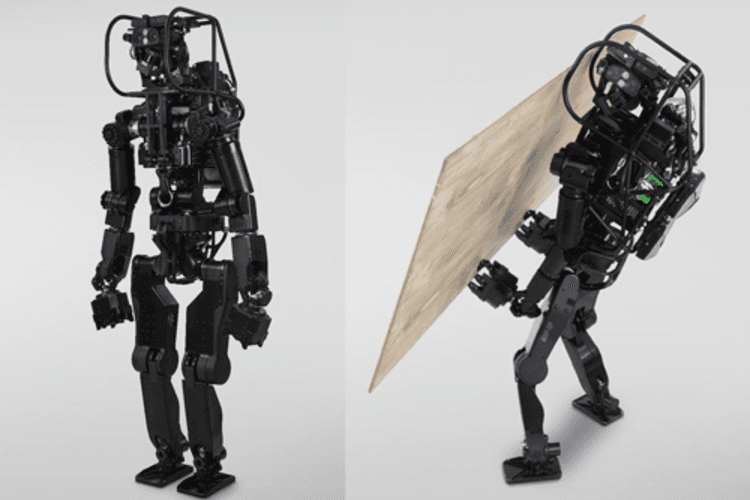
Researchers at the National Institute of Advanced Industrial Science and Technology (AIST), headquartered in Tokyo, have built a robot that can transport and hang drywall. Joining Fastbrick Robotics’ Hadrian X, a one-armed robot can lay up to 1,000 bricks an hour, and AutoSaw, a robot capable of cutting and transporting timber for use in walls, this robot plasterer signifies another major advancement in the world of construction robots.
The new robot, called HRP-5P, weighs 222.667 lb (101 kg) and stands at 5 feet, 11.654 in (182 cm), and was built to “autonomously replace human labor work and dangerous environment work,” said the team at AIST. The robot can lift “rug-sized” items and screw them into place using environment measure and object recognition technology.
Developed by AIST with the assistance of private enterprises including Kawada Robotics, HRP-5P employs some of the same mobility technology used in HRP-5P, another humanoid robotic created by AIST for disaster response scenarios.
HRP-2 offers more flexibility than HRP-2 and features a head complex sensor that allows for real-time, 3D measurements of surrounding areas. An image database makes use of high-precision augmented reality (AR) markers to ensure the robot picks up the right tools for every job.
Aiding the Construction Worker Labor Shortage
Eventually, construction robots like HRP-5P will likely be able to bring down both the cost and time associated with building applications, but right now, AIST is focused on filling the construction worker shortage.
“Along with the declining birthrate and the aging of the population,” AIST said, “it is expected that many industries such as the construction industry will fall into serious manual shortages in the future, and it is urgent to solve this problem by robot technology.”
The construction sector has been facing a skilled labor shortage for the past several years, resulting in higher costs and longer timelines for both residential and commercial projects across the country. With the older generation of construction workers retiring or set to retire in the near future, the industry has had a hard time finding skilled replacements.
To attract younger workers, construction companies have been working to reframe how the industry is perceived, ramping up the number of apprenticeship and educational opportunities available for millennials seeking steady jobs with high pay and room for growth.
But in the meantime, robotics may just prove a valuable alternative, helping to fill the skills gap facing the American construction sphere.
Image Credit: AIST