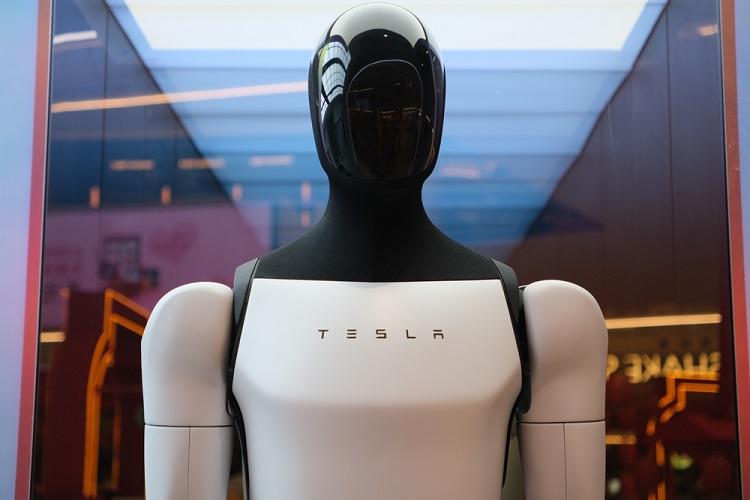
Despite originally being designed as household assistants, Tesla’s Optimus robots appear to have been assigned a much bigger task: exploring the surface of Mars.
Optimus on Mars
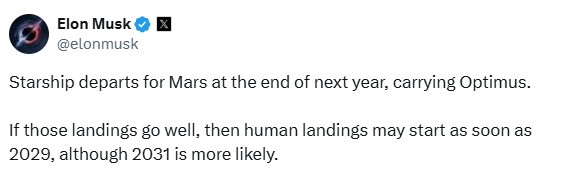
Elon Musk has announced plans to send Tesla’s Optimus robots to Mars—potentially by the end of next year, if all goes according to plan.
The announcement was made by Musk on Twitter on March 15, 2025.
Multiplanetary Goals
Musk has made his intentions of getting humans on Mars quite clear, with SpaceX—his aerospace company—working with NASA towards this goal. His vision is to build “a self-sustaining city in about 20 years” on the Red Planet.
The tentative plan is for an unmanned SpaceX Starship to launch in late 2026, carrying the humanoid Optimus robots as part of an early exploration mission. If successful, a similar mission involving astronauts could follow in the years after. However, no official mission has yet been confirmed for 2026.
Tesla’s Optimus
These robots, first introduced at the “We, Robot” event hosted by Tesla in October last year, are able to perform various domestic tasks, such as cleaning and basic chores. Musk has said they can do anything from walking the dog and mowing the lawn to babysitting and even being a friend.
Guests at the event were able to see these bipedal, autonomous robots in action, as several Optimus models were there, walking around and casually interacting with the attendees.
Skepticism on Timing
Not everyone is as optimistic as Musk about the timeline. Derrick Pitts, chief astronomer at the Franklin Institute in Philadelphia, stated that a Mars mission within a decade is unlikely, suggesting thirty years as a safer and more realistic timeline.
Professor of astronomy at the University of Arizona, Chris Impey, echoed the sentiment, noting that getting humans to Mars has a long learning curve, and cannot possibly happen in the next few years.
Image Credit: Shutterstock/Robert Way