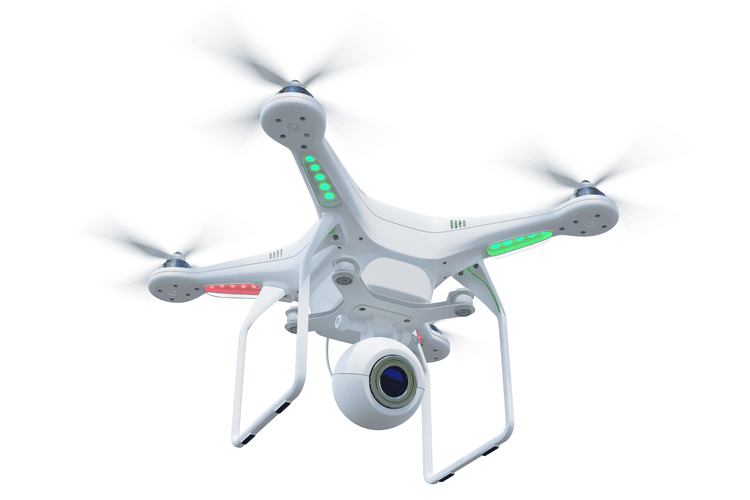
The use of drones beyond military applications has, so far, been relegated to capturing amazing aerial images and delivering small packages. However, researchers at the Massachusetts Institute of Technology (MIT) are currently experimenting with the use of drones for other industrial uses.
Although RFID tags can offer a number of efficiencies and traceability benefits, these codes and related scanners pose some complications for larger operations due to the manual scanning that still needs to be performed. In response, MIT researchers have developed a system that enables aerial drones to read RFID tags from up to 30’ away.
Applications for these warehouse drones could include continuous inventory monitoring in ensuring individual item counts are accurate and warehouse locations are correctly listed. Higher levels of accuracy could help insulate manufacturers and distributors against the wrong products being fed to work cells or sent to customers.
Another challenge for the research team arose when realizing the size restrictions that would need to be placed on these drones to ensure safe use in a warehouse environment. The drones that were small enough to navigate without risk to people or products were simply too small to carry RFID readers.
The researchers met this challenge by using the drones to relay signals emitted by a standard RFID reader. This not only ensures greater safety, but means that drones could be deployed in conjunction with existing RFID inventory systems, without the need for new tags, readers, or reader software. They’ve dubbed the system RFly.
To combat problems emanating from the high number of signals being sent and received by multiple tags and one drone, the researchers equipped each of their drones with its own RFID tag. A drone alternates between relaying the reader’s signal to a tagged item and its own. This lets its own tag reflect the signal back so that the code reader can estimate the drone’s contribution to the total phase shift and remove it.
In experiments that involved tagged objects in a warehouse environment, many of which were intentionally hidden, the system was able to localize the tags to within 7-1/2”. Testing will continue to further refine the results.
Insights
As ecommerce continues to play a more prominent role in B2C and B2B supply chains, efficiency-focused technology like this will be vital to stay competitive. Additionally, with factors such as shorter product lifecycles, quicker time-to-market expectations, and greater competition driving global sourcing initiatives, the ability to reduce error and fill orders or replenish production lines more quickly will be vital in staying relevant.