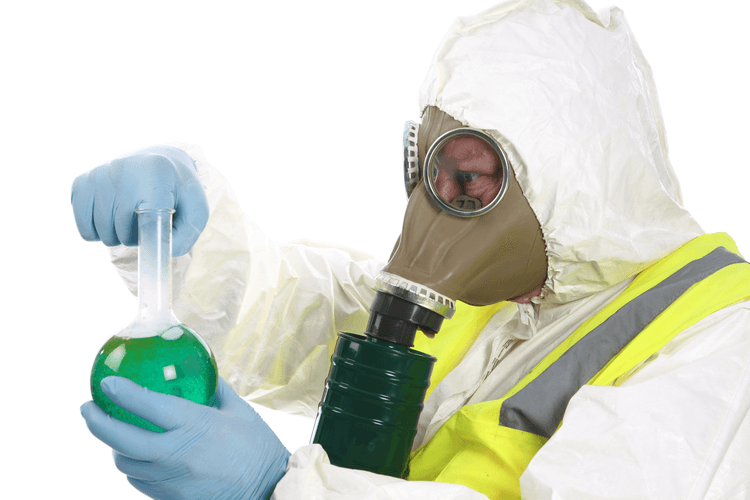
Clothing designed to protect human beings from the effects of nerve agents or poisonous gases have always proposed a number of challenges. They’re usually very heavy, very warm, hinder movement and are nearly impossible to decontaminate.
For these and more obvious reasons, researchers from North Caroline State University began investigating the use of lightweight, chemical-resistant coatings that could be integrated into clothing or uniforms. Their findings were recently published in the journal Chemistry of Materials.
Chemical weapons saw their first use in World War I. Their effects were so harsh that they were banned by the Geneva Convention and classified as weapons of mass destruction – along with biological and nuclear weapons. Regardless, a handful of countries still retain stockpiles of chemical weapons.
The N.C. State scientists explored the use of zirconium-based metal-organic framework (MOF) powders as a way to degrade and destroy the harmful compounds found in substances like mustard gas and sarin. MOFs are porous, but with large enough surface areas that they can absorb gases. Zirconium, which is essentially a chemical sponge, absorbs and neutralizes the toxic materials. Identifying these substances wasn’t the challenge.
MOF powders can be unstable, MOF production requires high temperatures and long reaction times, and the nature of the powder makes it difficult to adhere them to fabric. So, the research team investigated the potential for growing the MOFs onto fabric at room temperature. This would create a shield that could be embedded into uniforms and protective clothing.
Building on previous work, the researchers combined polypropylene with a zirconium-based MOF, a solvent and two binding agents. Then they tested this combination with a molecule similar to sarin and other nerve agents.
They found that the MOF-treated clothing deactivated the molecule in less than five minutes. The results are encouraging, but next steps will need to focus on the viability of mass production and quicker response times against more aggressive chemicals.