NASA is investigating how a new laser that fires pulses of light at 100 millionths of a nanosecond could change the way they produce instrument components. With long-term space colonization goals becoming a more frequent topic, this technology could also be a key platform for performing assembly function in space.
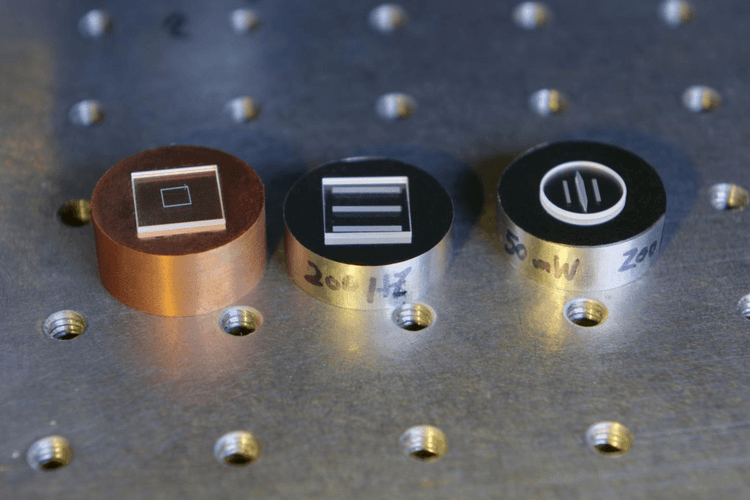
Optical physicists at the Goddard Space Flight Center in Greenbelt, Maryland are experimenting with a femtosecond laser that has shown the ability to effectively weld glass to copper and glass to glass, as well as drill hair-sized pinholes in different materials. New research is going down the path of more exotic glass materials like sapphire and Zerodur, and metals like titanium, Invar, Kovar, and aluminum. These are metals commonly used for instruments on spacecraft.
Specific applications could include adhering windows onto laser housings and optics to metal mounts. The approach also offers the potential to fabricate and package photonic integrated circuits – an emerging technology that could benefit communications, data centers, and optical sensors.
The laser, which sends pulses at one quadrillionth of a second, uniquely interacts with materials. Instead of melting the targeted substance, it vaporizes it without heating the surrounding matter. As a result, users can precisely target the laser and bond dissimilar materials that otherwise couldn't be attached without epoxies.
Another important application could be in micromachining. In the aerospace realm, this encompasses functions from drilling hair-sized pinholes in metals to etching microscopic channels through which light could travel in photonic integrated circuits and laser transmitters. These waveguides could also allow liquids to flow through the microfluidic devices and chips needed for chemical analyses and instrument cooling.
Image Credit: NASA/W. Hrybyk